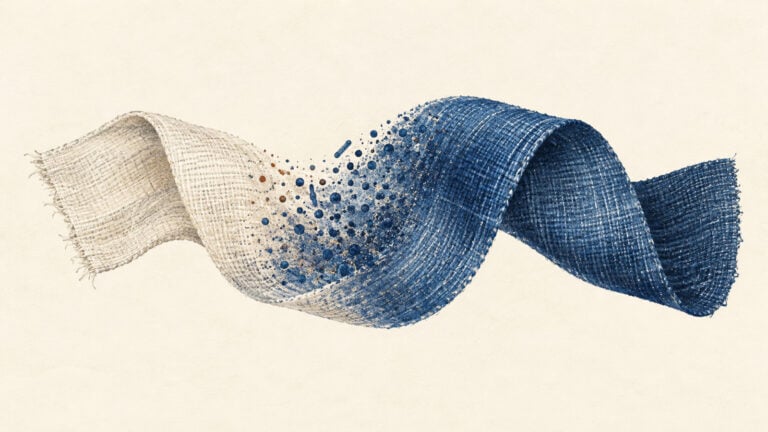
In a small French town called Saumur, a little girl named Gabrielle Bonheur Chanel was born in 1883. Her life began in extreme poverty as her unmarried parents struggled to make ends meet. Little did anyone know that this child born into hardship, would one day become Coco Chanel, an icon who would change the fashion world forever.
Tragedy struck the young Gabrielle when she was just 12 years old. Her mother died and her father, unable to care for his five children, sent Gabrielle and her sisters to an orphanage run by nuns.
It was a hard and lonely existence, but it was here that Gabrielle learnt to sew. This skill would later become the foundation of her empire.
The Stage to the Atelier
As Gabrielle grew into a young woman, she began singing in cabarets in Vichy and Moulins, where she earned the nickname ‘Coco’. But Coco dreamed of more than just singing on stage. She wanted to create, to design, to make her mark on the world. As she had no formal training in the fashion industry, Coco relied on her natural talent and intuition.
She began designing hats and opened her first shop in Paris in 1910 with the help of wealthy men she met along the way, such as Étienne Balsan and Arthur ‘Boy’ Capel. These relationships introduced Coco to the world of high society and influenced her designs and creative vision. Her simple, elegant creations quickly attracted the attention of the Parisian elite and her business began to grow.
Necessity: The Mother of Invention
Coco’s perseverance and inventiveness were evident in her early days as a designer. When she couldn’t afford to buy fabric for her hats, she would visit local flea markets and repurpose old jerseys and other materials. This innovative use of unconventional fabrics would later become a characteristic of her designs, particularly during the First World War when fabric was scarce.
Chanel’s use of jersey fabrics was not only practical but also well-suited for the uniforms prevalent during the war and showed her ability to respond to the needs of women in difficult times.

Redefining Fashion
But Coco’s path to success was not easy. She faced many challenges, including the outbreak of the First World War, which forced her to temporarily close her business. Undeterred, Coco used this time to experiment with new designs and fabrics, including jersey, which was traditionally used for men’s underwear.
She saw the potential of this comfortable and practical material and used it to create garments in which women could move and breathe freely – a departure from the restrictive corsetry of the time. As Coco once said:
“Luxury must be comfortable, otherwise it is not luxury.”
Chanel’s designs emphasised comfort and practicality and liberated women from the confines of traditional fashion. Her iconic creations such as the little black dress, the little black jacket, the Chanel suit, the quilted bag and the Chanel No. 5 perfume reinvented women’s fashion and remain timeless classics to this day.
These designs not only showcased Chanel’s creativity, but also reflect her understanding of the needs and desires of the modern woman.
Her stripped-back aesthetic stood in direct opposition to the surrealist extravagance of Elsa Schiaparelli, her most formidable rival, whose theatrical designs defined the other pole of 1930s fashion.
Rising from the Ashes
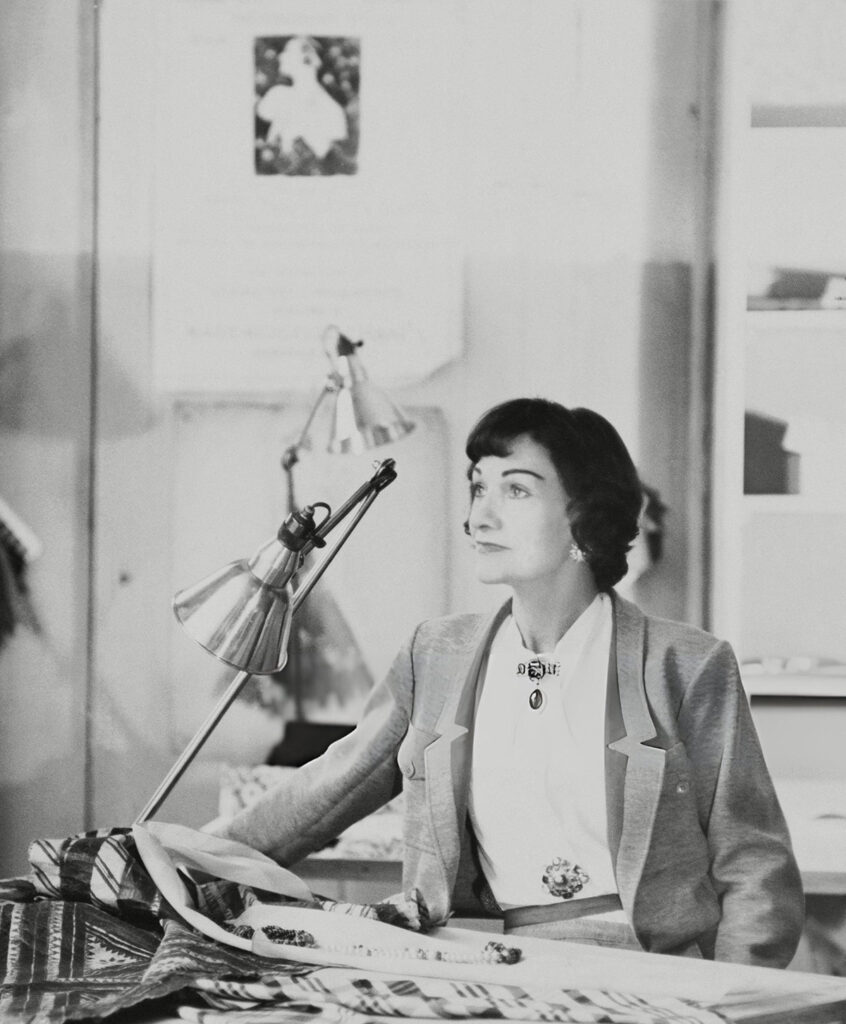
As her fame grew, Coco’s private life became more complex. She had a series of high-profile liaisons, including with the Duke of Westminster and a German officer during the Second World War. The latter relationship led to accusations of collaboration with the Nazis and damaged her reputation after the war. Coco was forced to close her salon and live in exile in Switzerland, experiencing one of the darkest periods of her life.
But Coco refused to be defeated. In 1954, at the age of 70, she made a triumphant return to the fashion world and reopened her fashion house. She introduced a new collection that showcased her signature elegance and simplicity, including the legendary Chanel suit and the iconic Chanel jacket. Women around the world fell in love with her designs all over again, and Coco reclaimed her place as a fashion icon, proving her resilience and enduring passion for fashion.
Her 1954 collection would prove influential on a new generation of designers, among them Yves Saint Laurent, whose complex relationship with the Chanel aesthetic would shape the next chapter of haute couture. After her death in 1971, the house she built passed through several hands before Karl Lagerfeld took creative control in 1983, directing it for thirty-six years.
My life didn’t please me, so I created my life
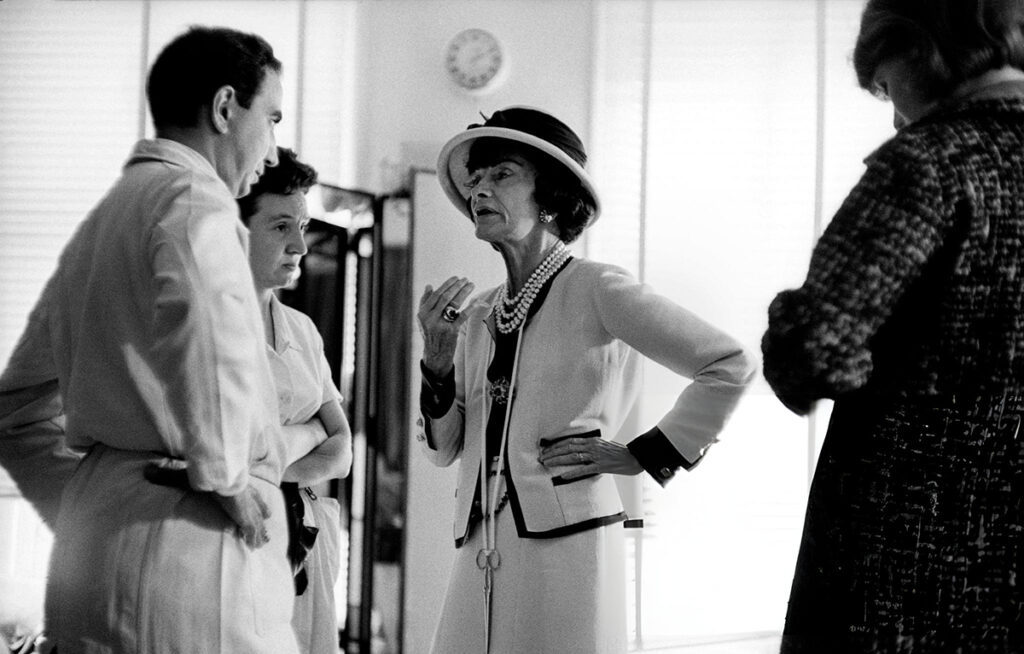
Throughout her life, Coco faced numerous obstacles, from poverty and lack of education to personal scandals and war. But she never let these challenges get her down. Instead, she used them as inspiration for her designs and created fashion that encouraged women to be bold, confident and true to themselves. As Coco once explained:
“The most courageous act is still to think for yourself. Aloud.”
Coco’s wit and sharp tongue were as legendary as her designs. “A girl should be two things: who and what she wants,” she famously said. Her courageous attitude and commitment to her vision inspired generations of women to embrace their individuality and challenge social norms.
From the little orphan girl who learnt to sew to the fashion icon who changed the world, Coco Chanel’s journey is a reminder of the transformative power of creativity, passion and tenacity. Her life and work inspire generations of women to embrace their individuality and chase their dreams, no matter the obstacles they face.
As Coco herself once said, “My life didn’t please me, so I created my life,” and what a remarkable life it was!
Sources & References
This portrait draws on biographical and historical sources including Britannica, Biography.com, Cambridge Core, The Metropolitan Museum of Art, and The Guardian, alongside primary archival material from Classic Chicago Magazine and Lausanne Palace.
- Coco Chanel Biography: Britannica — A comprehensive overview of Chanel’s life and impact on fashion. https://www.britannica.com/biography/Coco-Chanel
- Coco Chanel: Quotes, Fashion & Facts: Biography.com — Details on Chanel’s life, quotes, and her influence in the fashion industry. https://www.biography.com/history-culture/coco-chanel
- From the Margins to the Core of Haute Couture: The Entrepreneurial Journey of Coco Chanel: Cambridge Core — An academic article on Chanel’s rise in the fashion industry. https://www.cambridge.org/core/journals/enterprise-and-society/article/from-the-margins-to-the-core-of-haute-couture-the-entrepreneurial-journey-of-coco-chanel/2EB663E94E9C67F6CB3B9CF962242FAD
- Coco Chanel: How World Wars Built a Fashion Empire: Lyons Feel — Discusses Chanel’s innovations during wartime. https://www.lyonsfeel.com/essays/2020/5/18/coco-chanel-how-world-wars-built-a-fashion-empire
- Gabrielle “Coco” Chanel and the House of Chanel: The Metropolitan Museum of Art — Insights into Chanel’s early success and use of jersey fabric. https://www.metmuseum.org/toah/hd/chnl/hd_chnl.htm
- How the First World War Changed Women’s Fashion: The Guardian — Article on the influence of World War I on fashion, including Chanel’s role. https://www.theguardian.com/fashion/2014/nov/10/how-the-first-world-war-changed-womens-fashion
- A Pioneer of Women’s Liberation: Modern Diplomacy — Highlights Chanel’s impact on women’s fashion and societal norms. https://moderndiplomacy.eu/2020/09/09/a-pioneer-of-womens-liberation/
- Coco Chanel’s Secret Life as a Nazi Agent: Biography.com — Explores Chanel’s controversial relationship during WWII. https://www.biography.com/history-culture/coco-chanel-nazi-agent
- How Coco Chanel Spent Her Exile in Switzerland: Lausanne Palace — Details Chanel’s life in Switzerland after WWII. https://www.lausanne-palace.ch/fileadmin/documents/lausanne-palace.ch/pdf/Presse/Articles_de_presse/Coco_Chanel_EN.pdf
- Coco Chanel — Her Re-Entry: Classic Chicago Magazine — Insights into Chanel’s comeback in the fashion industry. https://classicchicagomagazine.com/her-rentry/
- Coco Chanel Quotes: ThoughtCo — A collection of Chanel’s famous quotes on fashion and life. https://www.thoughtco.com/coco-chanel-quotes-p2-3525384