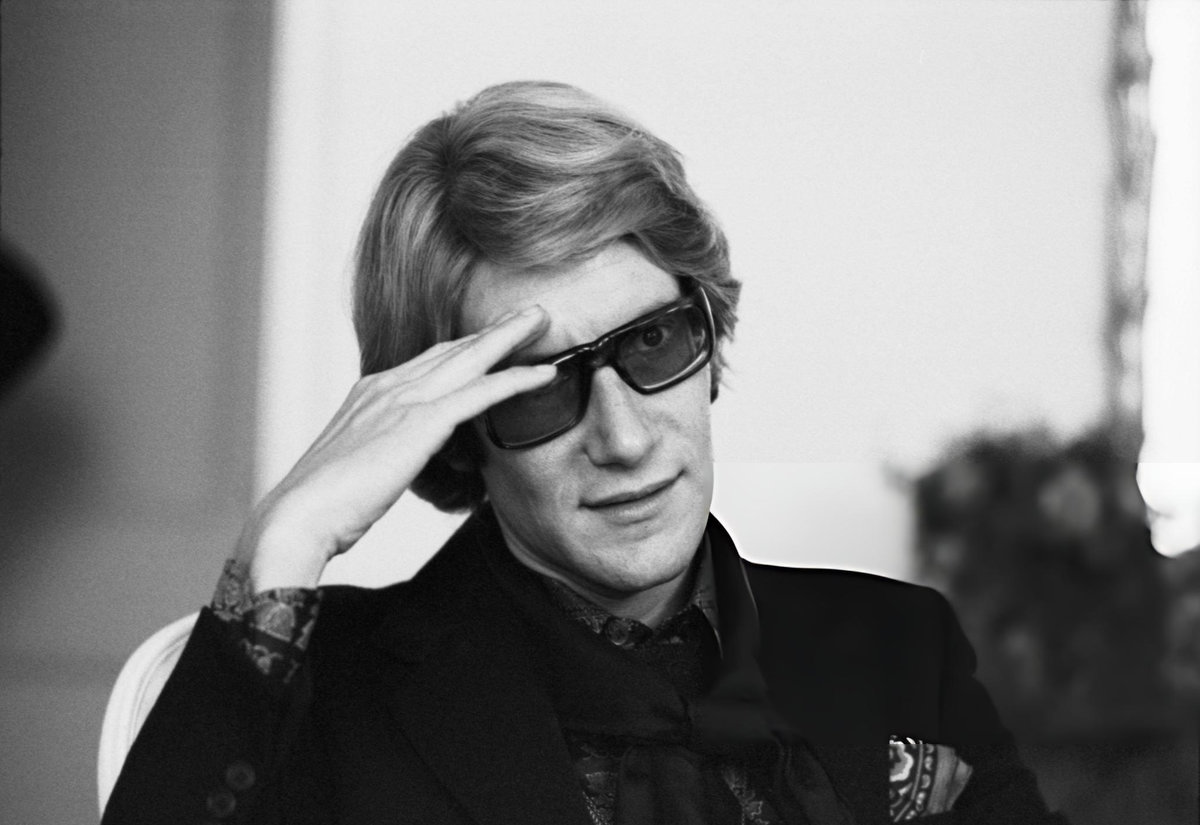
In December 1983, Yves Saint Laurent told Le Monde that he had always been a “shy, thoughtful dreamer, terrorised by classmates” — a man constitutionally at war with the ordinary world. He had been refining this account for years. Karl Lagerfeld, Saint Laurent’s principal rival for three decades, found it unconvincing — and was not a disinterested witness. “It is an absurd idea when he says he didn’t have a youth,” Lagerfeld told W Magazine. “I knew him myself when he had one.” The young Saint Laurent Lagerfeld recalled had a single clear ambition: “to be rich and famous.” He was also, Lagerfeld added, “one of the funniest people alive.” The martyr had not yet been invented.
French biographer Marie-Dominique Lelièvre spent two years investigating when the invention began. Her 2010 book Saint Laurent, mauvais garçon — largely invisible outside France — pinpointed the moment precisely. “Saint Laurent began to deteriorate from around 1976–1977,” she wrote. What followed was not a revelation of a lifelong condition. It was a character built around a specific collapse: “the artist struck down by his own genius.” The defining claim came from Pierre Bergé — Saint Laurent’s life companion and the business architect of the house — who told the world that Saint Laurent “was born with a nervous breakdown.” The doctor Lelièvre consulted disputed this directly. A depressive, the doctor noted, has no energy. Saint Laurent had considerable energy.
The mid-1970s were the turning point. Saint Laurent had conquered couture, launched Rive Gauche, and dressed a generation of women in trouser suits and safari jackets. He had also entered the world that Alicia Drake mapped in The Beautiful Fall — a Paris of all-night clubs, chemical excess, and the orbit of Jacques de Bascher, Lagerfeld’s companion and Saint Laurent’s obsession. Betty Catroux, his closest confidante, later described what that period truly was: “With Yves, we took the strongest things… everything that went straight to our heads, so as not to be in reality. The goal was to flee everyday life.”
Free weekly newsletter
Get every new profile directly in your inbox.
The human stories behind the most constructed public personas — delivered free.
What Catroux describes is not illness. It is a decision, repeated daily, to disappear.
The myth reframed that decision as fate. By the early 1980s the narrative of innate suffering had settled into place — and it served people beyond Saint Laurent himself. Bergé’s role as indispensable caretaker required a Saint Laurent who could not function independently. Lelièvre recorded testimony that Bergé had “sustained YSL in his weaknesses, to the point of making him dependent.” She relayed it without endorsing it — but she recorded it where the official biography had not.
Bergé’s earlier testimony complicates the origin story he later recounted. In a 1987 television interview with Thierry Ardisson, he borrowed a phrase from Cocteau to describe Saint Laurent — a man who “enjoys a robustly bad health.” His later Numéro interview was more explicit: “with Yves, the roles were distributed from the beginning.” He loved Saint Laurent, Bergé said, “for his fragility, for his difficulty in grasping everyday life.” That framing — stable caretaker, fragile dependent — extended backwards across a relationship whose early years Lagerfeld, rival or not, remembered rather differently.
Saint Laurent did not contest it. On 7 January 2002, at his studio on avenue Marceau, he read his retirement statement to journalists and described, in his own words, “the prison of depression and that of the nursing homes.” It was the closest he came, publicly, to speaking without the myth surrounding him. He closed with a single sentence: “Je ne vous oublierai pas.” I will not forget you. Whether that character had ever been separable from the man, the record does not say.