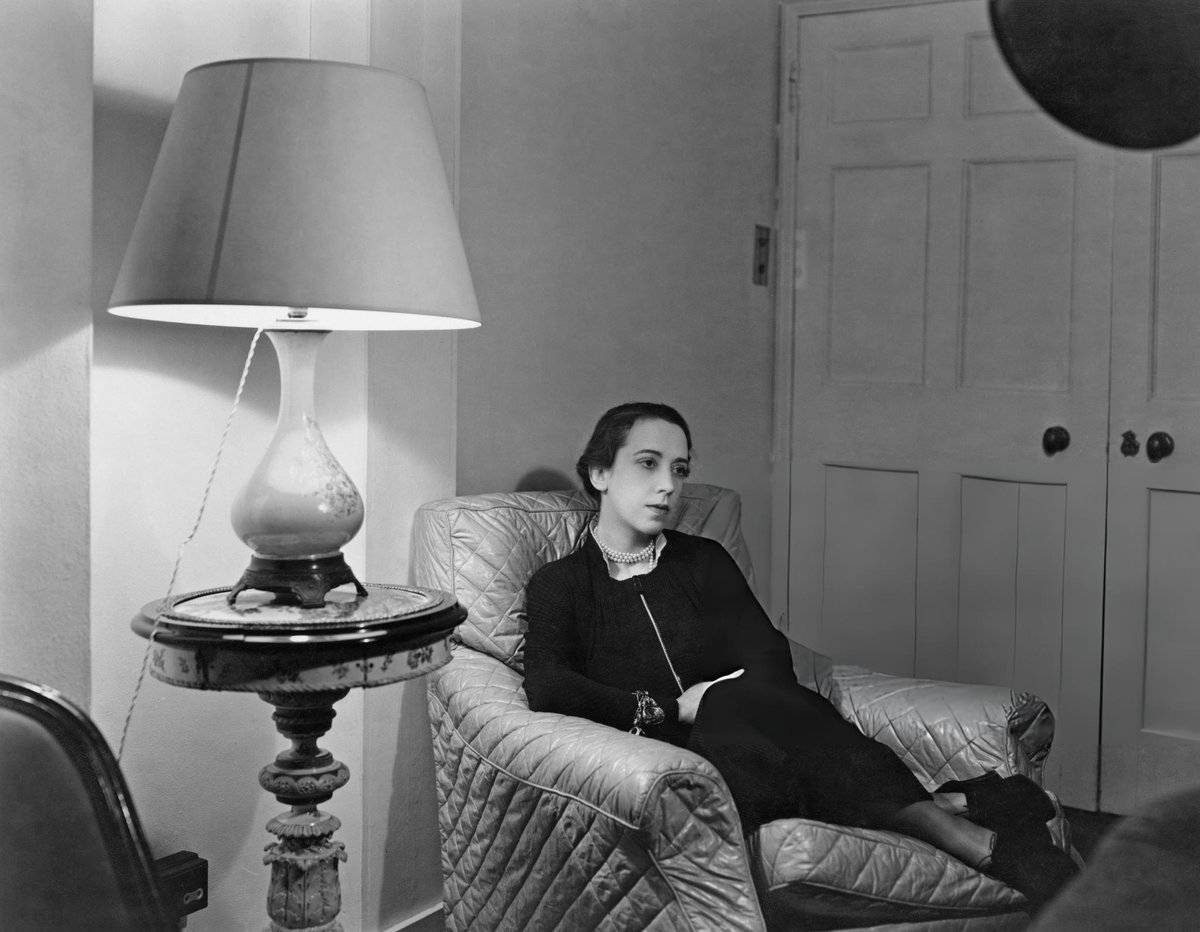
Elsa Schiaparelli does not appear in most history books. She should. In the 1930s, she ran one of the most influential fashion houses in Paris — rivalling Coco Chanel, collaborating with Salvador Dalí, and dressing everyone from Marlene Dietrich to the Duchess of Windsor. She invented shocking pink as a colour name. She put a lobster on a dress and called it couture. She dressed powerful women at a moment when being powerful and female required a particular kind of armour.
She also closed her house in 1954 and spent the rest of her life largely forgotten — by an industry she had helped to build.
This is not a story about fashion. It is a story about a woman who turned personal damage into a creative system, and who did it decades before the language existed to describe what she was doing.
She was seven, perhaps eight, when she decided to grow flowers from her own face. Having gathered seeds of nasturtiums, daisies and morning glories, she planted them in her ears, her mouth, her throat. She was waiting to become beautiful. When nothing grew, she recorded the disappointment without self-pity — a child’s flat precision. It was, she wrote decades later, the moment “the struggle had begun.”
The struggle never ended. It simply changed medium.
Elsa Schiaparelli was born in Rome in 1890 into a family that delivered its verdict early. Her sister was the beautiful one. Elsa was told so directly, and often enough that she absorbed it as fact. Her mother’s “disparaging remarks about her looks” are documented in her own autobiography, Shocking Life, published in 1954. In it, she refers to herself throughout as “Schiap” — a third person who lives at a useful distance from the girl who was found wanting. “I merely know Schiap by hearsay,” she wrote on the opening page. “I have only seen her in a mirror. She is, for me, some kind of fifth dimension.”
The distance was not stylistic. It was structural.
By the late 1920s, working from an attic showroom in Paris with almost no capital, she had begun converting the ugliness verdict into an aesthetic system. The angularity her mother had mourned became the new standard. In 1933, her longstanding collaborator Bettina Bergery described the ideal Schiaparelli woman as possessing “features sometimes frankly irregular; a slim polished directness that seems to emphasize angles rather than curves; hair sculpted close to the head; a profile that is strong.” The description was, without coincidence, a precise physical portrait of Schiaparelli herself. She had not overcome her mother’s judgment. She had made Paris agree with it.
The surrealist provocations of the 1930s — the lobster dress, the shoe hat, the skeleton silhouette — are routinely attributed to her alliance with Dalí. Biographer Meryle Secrest, who drew on FBI records and court documents for her 2014 biography, advances a different argument. The shock was not art-world affiliation. It was autobiography. Schiaparelli had been told that her appearance was wrong; she spent her career insisting that wrong was precisely the point. As Rosemary Hill observed in the London Review of Books, “she managed to make the ugly duck style fashionable. For more than a decade between the two world wars, smart women in Europe and America wanted to look like ‘Schiap’.” The mother’s verdict, industrialised at scale.
The pattern reproduced itself at home. Her only child, Gogo, was born in 1920 and contracted polio in infancy. While her daughter underwent treatment in a Swiss clinic, Schiaparelli returned to Paris to build her career. Gogo, asked decades later about her mother’s maternal habits, answered with the compressed precision of someone who had long ago made her peace with the facts. “Dashing out of the door,” she recalled, her mother would always call: “Well, I must go now.” The child would look up and say, “Go, go, going, go, go.” The nickname stuck. “Ironically,” Gogo observed, “it describes Mother’s maternal pattern perfectly.”
Schiaparelli’s first husband, Wilhelm de Kerlor, had prepared her well for a life structured around departure. He was, as journalist Justine Picardie documented from court records, convicted in London in 1915 of “being a rogue and a vagabond by pretending to tell fortunes” — fined and deported to France. He abandoned Schiaparelli and their newborn days after Gogo’s birth. Secrest’s assessment of his role is precise: “It was through him and his antics that Schiap perfected showmanship and self-promotion.” The charlatan who vanished taught her how to perform.
Coco Chanel, asked about her greatest rival, delivered her verdict in five words: “That Italian artist who makes clothes.” The dismissal stripped Schiaparelli of her Frenchness, her professional standing, and her claim to the house she had built. Yves Saint Laurent saw what had actually been constructed. “She slapped Paris. She smacked it. She tortured it. She bewitched it. And it fell madly in love with her.”
In Shocking Life, she had named the desire for autonomy as her defining need: “the possibility of going out alone at any time, anywhere, has always excited my envy.” She spent forty years performing that freedom for an audience of millions. A letter survives from 1971, written to her close friend Frances Farquharson. It closes: “Darling, when are you coming next?”