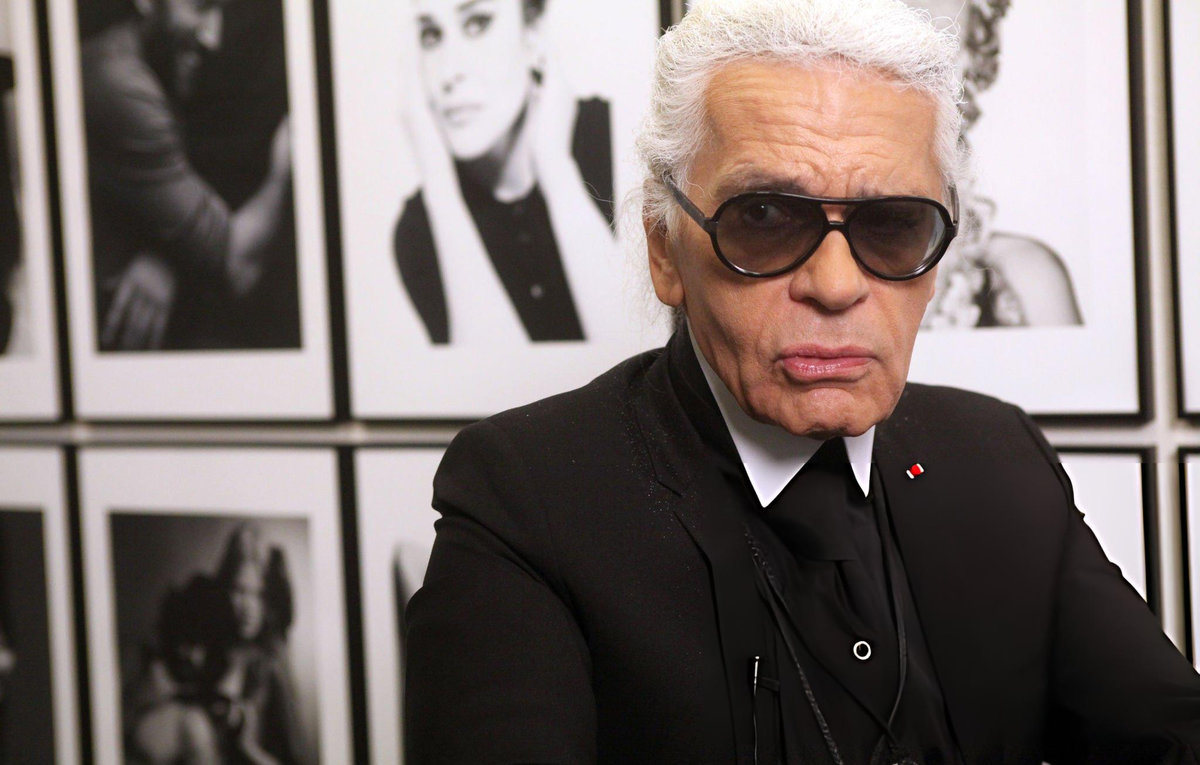
Karl Lagerfeld was born on 10 September 1933 in Hamburg — the year Hitler became Chancellor of Germany. He spent the next seven decades insisting otherwise. When Bild am Sonntag published his baptismal records in 2008, he appeared on French television and stated: “I was born neither in 1933 nor 1938.” His publisher Gerhard Steidl believed he had falsified his passport. Biographer William Middleton concluded the fabrication served one purpose: born in 1938, he was too young to have witnessed anything. But the displaced years were not only about Germany. They were the first evidence of a decision Lagerfeld appears to have made sometime in the early 1950s — to replace the person he had been with a person entirely of his own construction. A sharper wit. A harder surface. A man who needed nothing and regretted less. He maintained that replacement for 60 years. The question is what it cost.
The replacement was built on specific wreckage. André Leon Talley documented in The Chiffon Trenches that Lagerfeld’s mother, Elisabeth Bahlmann, strapped him to the bed with leather restraints to prevent him from eating at night. When he was eight, she told him, “You look like me, but not as good.” She attended none of his fashion shows, saying she preferred other designers. She kept two binders of every press clipping he had ever sent her. She did not ignore him. She consumed the achievement and withheld the recognition. A child raised on that learns one thing precisely: that the person he is will never be sufficient. Lagerfeld’s response was not to seek recognition or revenge. It was to stop being that person entirely.
Beginning November 2000, Lagerfeld lost 88 pounds in 13 months — motivated by a desire to fit into Hedi Slimane’s silhouettes, not by health. His daily intake was limited to 1,200 calories. He described the process as “a kind of punishment”.
Jacques de Bascher entered Lagerfeld’s life in the early 1970s and remained until his death from AIDS in 1989. Lagerfeld told journalist Marie Ottavi that he “infinitely loved that boy” but had no physical contact with him — desire delegated, intimacy maintained at a precise distance. He described himself as “a total puritan” while funding de Bascher’s BDSM events throughout the decade. His dying wish was for his ashes to be mixed with those of de Bascher and his mother. The replacement could fund desire and mourn its object completely. What it could not do was inhabit the relationship.
The replacement’s most revealing habit was what it did with evidence. In a beach photograph from Deauville, 1956, Yves Saint Laurent — once among Lagerfeld’s closest friends — had been digitally removed. In his place: a mound of sand. Middleton, who was shown the image during research for Paradise Now, noted the gap between the public harshness and the private warmth he had witnessed. Lagerfeld’s explanation arrived without hesitation: “I am this person who pulls the chair out, and it could be 10 years after it happened.” Journalist Alicia Drake, who spent years interviewing Lagerfeld’s circle for The Beautiful Fall, identified the mechanism precisely: “His controlling coldness hardened into the faux aristocratic persona he still affects.” The persona and the coldness were not separate. The persona was the coldness, formalised.
The pattern extended to people. Inès de la Fressange received what no model before her had been given — an exclusive Chanel contract, singular visibility, and Lagerfeld’s personal patronage. In 1989, she agreed to model as Marianne, France’s national symbol, without consulting him. He ended it publicly and without appeal. “I wish her all the luck in the world,” he said, “just so long as I don’t have to see her anymore or hear her spoken about.” Talley, who had known him for four decades before his own expulsion, wrote that Karl “had a tendency to banish people he loved from his life” — not with confrontation but with silence. The silence was total and it was permanent.
In a Vice interview, filmmaker Bruce LaBruce asked Lagerfeld directly about loneliness — whether the armoured public persona ever gave way to something more vulnerable. “I never have the feeling of being alone,” Lagerfeld answered. Several questions later, he revealed that when he had reported a paedophilic approach as a child, his mother told him: “It’s your fault. You see how you behave.” He offered both answers in the same register, without apparent awareness of what they revealed in proximity: the adult who claimed never to feel alone, and the child who had been left to face fear by himself. The replacement had been so thoroughly maintained that the distance between those two answers was no longer visible to the man giving them.
Middleton’s biography documents a warm, privately generous man. Talley’s memoir documents a friend who, in the end, became a casualty. Lagerfeld was, by most accounts, extraordinary — disciplined, original, genuinely kind to those he chose to keep. What the replacement could not be was the person it had replaced. That person had been made to feel, at eight years old, in a bed with leather restraints, that he was not quite good enough to exist. The replacement solved that problem. It solved it for 60 years. Whether that counts as a triumph or a loss is a question Lagerfeld never answered — and never considered worth asking.