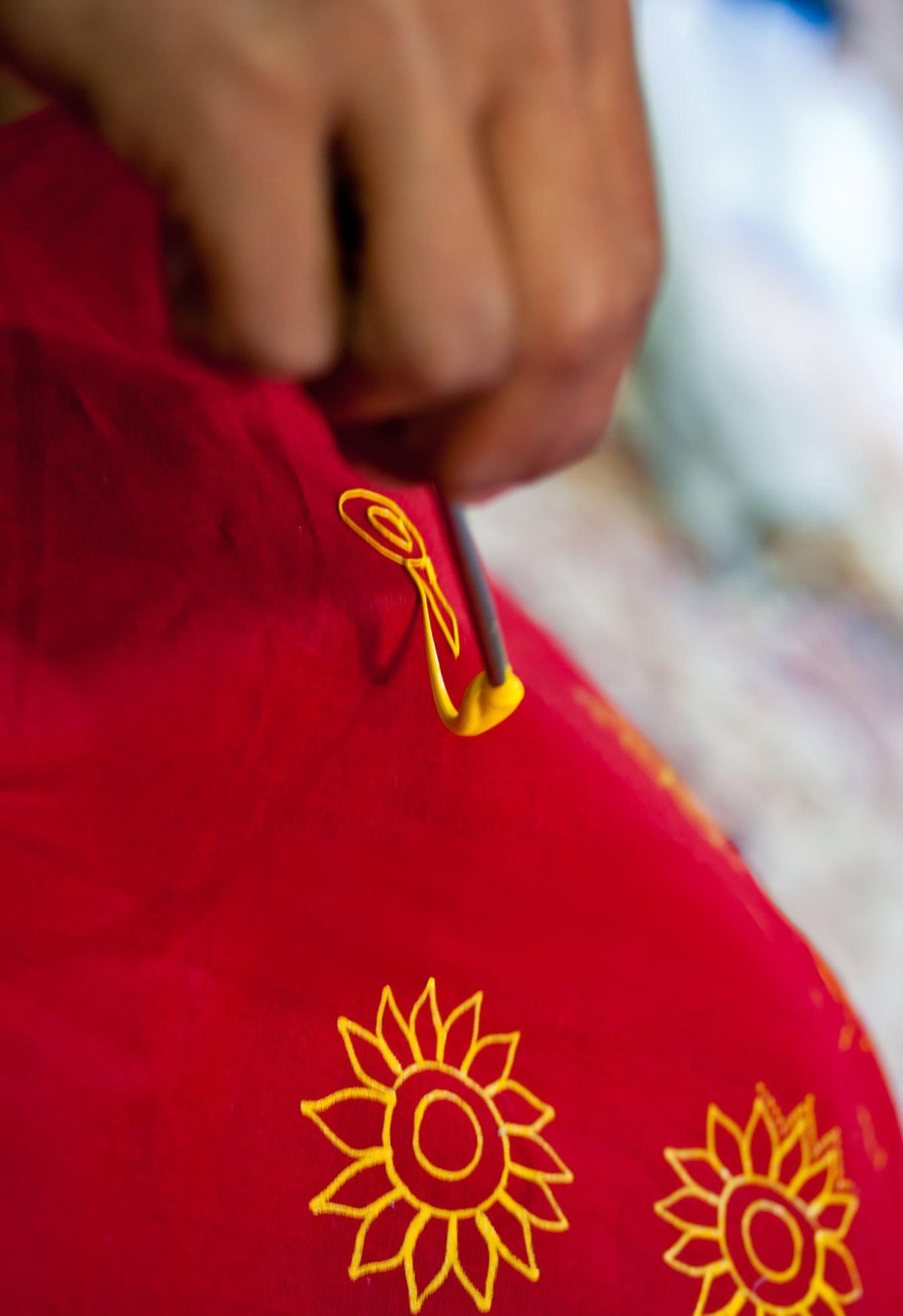
In Nirona village, in Gujarat’s Kutch district, a metal stylus moves across dark fabric without once touching it. The paint — castor oil boiled for two days and mixed with natural pigments — travels above the cloth as a thread. Intricate patterns emerge entirely from memory, with no sketch or prior reference.
When the fabric folds at the midpoint, the wet design mirrors itself exactly. Two identical pieces emerge from a single act of painting. This is rogan kaam — cloth work, in Persian — a technique practised in Kutch for roughly 400 years.
It is now practised by one family on earth. That singularity is not a point of pride. It is a measure of how close the craft came to vanishing permanently.
Free weekly newsletter
Get every new story directly in your inbox.
Craft Heritage features of artisan traditions — and the pressures they face — delivered free.
By the late 1980s, cheap industrial textiles had eroded demand until both brothers left Nirona for factory work — Abdul Gafur for Mumbai, Sumar not far behind. In 1985, their grandfather summoned them back for a government revival project. Neither brother left again.
The revival that followed earned the family four National Awards. In 2019, Abdul Gafur received the Padma Shri — India’s fourth highest civilian honour. What the revival did not resolve was the income model.
The family rebuilt through a single channel: direct sales to tourists visiting Bhuj, 25 miles from the Nirona workshop. Larger Rogan wall art pieces, which can take weeks to complete, sell for over $1,000. When visitors came, the model held.
When the COVID-19 pandemic stopped them, there was nothing else. Twenty trained women workers were laid off as business contracted. Abdul Gafur Khatri described the situation: “I can tell you that we have incurred losses because tourists didn’t come, and this business depends on them. There’s no other source. So what do we do? Now we are just waiting and watching to see what will happen next.”
“Rogan is a one man army, sustaining without anybody’s support and finding its way to reach maximum people.” Sumar Khatri — National Award winner and the craft’s co-revivalist — stated the structural problem more plainly than any outside analysis could.
The family had by then reached Lakmé Fashion Week and New York Fashion Week. Prime Minister Modi presented a Rogan painting to President Obama. Abdul Gafur named the gap between that visibility and economic security without ambiguity: “I am happy my art is travelling, but now I want it to survive.” The prestige had not produced a second revenue channel.
The generational response is being built by Jabbar Khatri, nephew of Abdul Gafur. His approach does not wait for tourists. He conducts paid workshops at national design and fashion institutions, creating income independent of visitor numbers. He sells through Instagram and online marketplaces, shipping internationally by courier. In 2023–24, he received first prize at the Digital Artisans of India Award for this work.
In 2025, Kutch Rogan Craft received a Geographical Indication tag. It is a formal mechanism protecting the craft’s regional and cultural identity. Whether the income from workshops and online sales has yet replaced what the pandemic removed is not on record.
Heritage protection and market infrastructure are not the same instrument, and the Khatri family’s experience demonstrates the difference precisely. Recognition sustains a craft’s legitimacy. Revenue sustains its practitioners. The family has built the first across eight generations of award-winning work. The second is now being constructed, deliberately, by the generation that grew up watching the limits of the first.