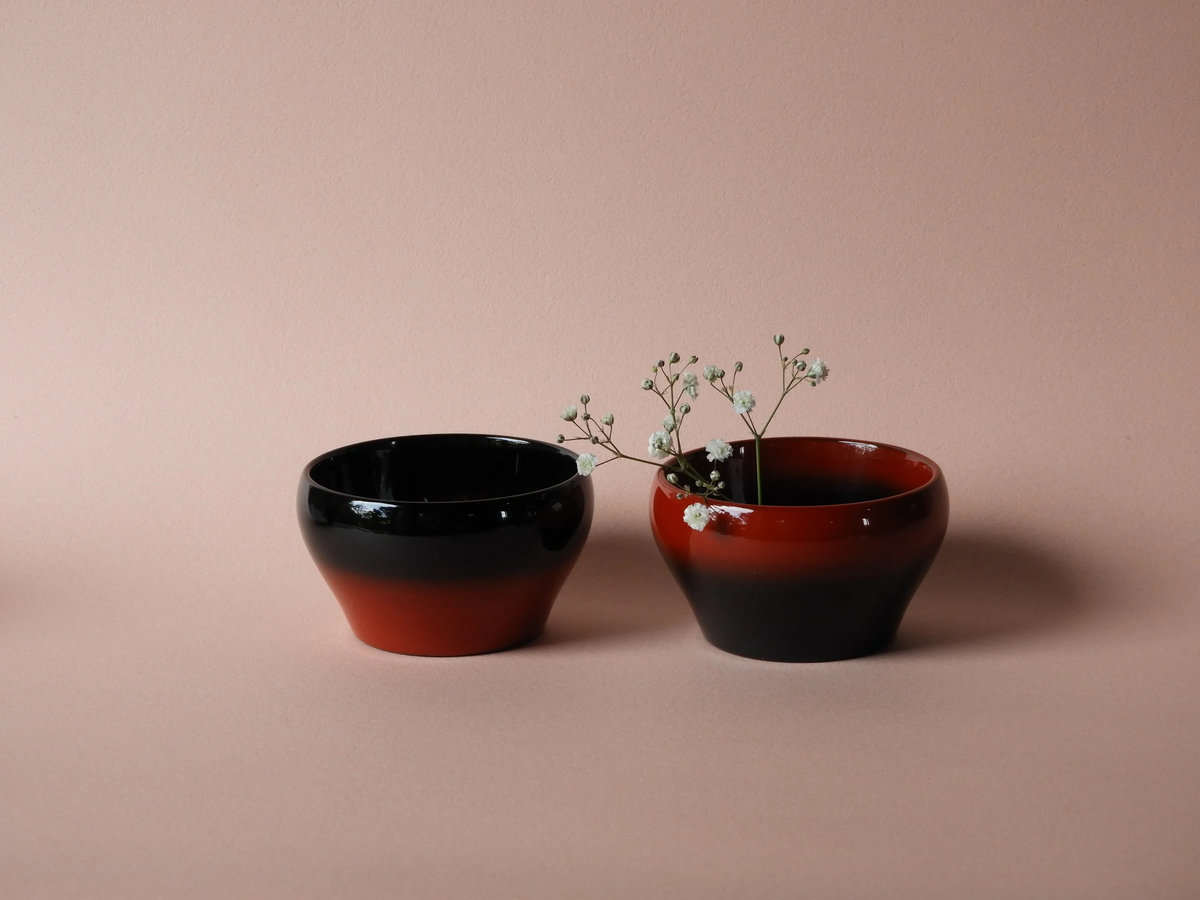
In a Japanese workshop, a single piece of lacquerware can take four years to complete. The wood is shaped, then linen-bound, then coated in lacquer drawn from the sap of a tree. Each layer must dry in controlled humidity before the next is applied.
Charcoal — not modern abrasives — does the polishing between coats. Twenty layers is the minimum. A piece of Wajima-nuri lacquerware can require more than 100 stages of production.
The craft is urushi — Japanese lacquerwork, and one of the most archaeologically verified living traditions in the world. Murose Kazumi was designated a Living National Treasure in 2008 for togidashi maki-e, a technique in which gold designs are buried in lacquer and revealed by polishing. “Lacquer art might be called the decorative expression of light,” he has said.
Free weekly newsletter
Get every new story directly in your inbox.
Craft Heritage features of artisan traditions — and the pressures they face — delivered free.
Lacquered objects from the Kakinoshima B site in Hokkaido have been radiocarbon-dated to roughly 9,000 years ago. Wood from the lacquer tree itself is older still. A sample from the Torihama Shell Midden in Fukui dates to around 12,600 years ago.
The Nara period (710–794) brought a new decorative form to a craft already nine thousand years in practice. Artisans invented maki-e: gold or silver powder sprinkled onto wet lacquer, buried under further coats, and revealed by burnishing.
Nine centuries on, the Edo period (1603–1868) gave the world kintsugi: the repair of broken ceramics with lacquer mixed with gold. The fracture is treated as part of an object’s history, not its disfigurement.
What connects every technique across those centuries is Toxicodendron vernicifluum, the lacquer tree. Its sap, caustic to the skin, is the only true ingredient.
A single tree takes 10 to 15 years to mature. The sap is drawn during the rainy season, through horizontal cuts in the bark. One tree yields roughly a cupful — between 180 and 200 grams — and is then felled.
Murose has described a single A4-sized piece taking him three to four years, from plan to finished object. Urushi hardens with time and becomes more transparent. Well-preserved pieces, he has said, can retain their beauty for five centuries — provided the knowledge to make them survives as long.
Murose’s own teacher was a Living National Treasure. Techniques, he has said, are “learned by heart through the experience of making mistakes over and over.” Suzanne Ross, a British artist, arrived in Wajima in 1984 knowing none of this.
She expected to learn urushi in three to six months; she has now spent over 30 years there. “You don’t master them, they master you,” she has said.
The skill cannot be acquired in a season. Murose has said that industrial products may possess aesthetic beauty but lack a sense of spirituality. The sap cannot be synthesised without losing its character.
About 97 per cent of urushi used in Japan is imported, according to Takuo Matsuzawa of the Joboji Urushi Workshop. Sachiko Matsuyama, founder of Kogei no Mori, has documented a collapse in domestic production from roughly 2,000 tonnes a year before 1850 to around 30 tonnes by 2019.
The January 2024 earthquake on the Noto Peninsula was catastrophic for Wajima. Seventeen of the 103 lacquer companies were destroyed and 50 more damaged. The city’s craftspeople scattered.
Climate disruption has made the tapping season itself unstable. Murose has reported being unable to cut a urushi tree, for the first time in his life.