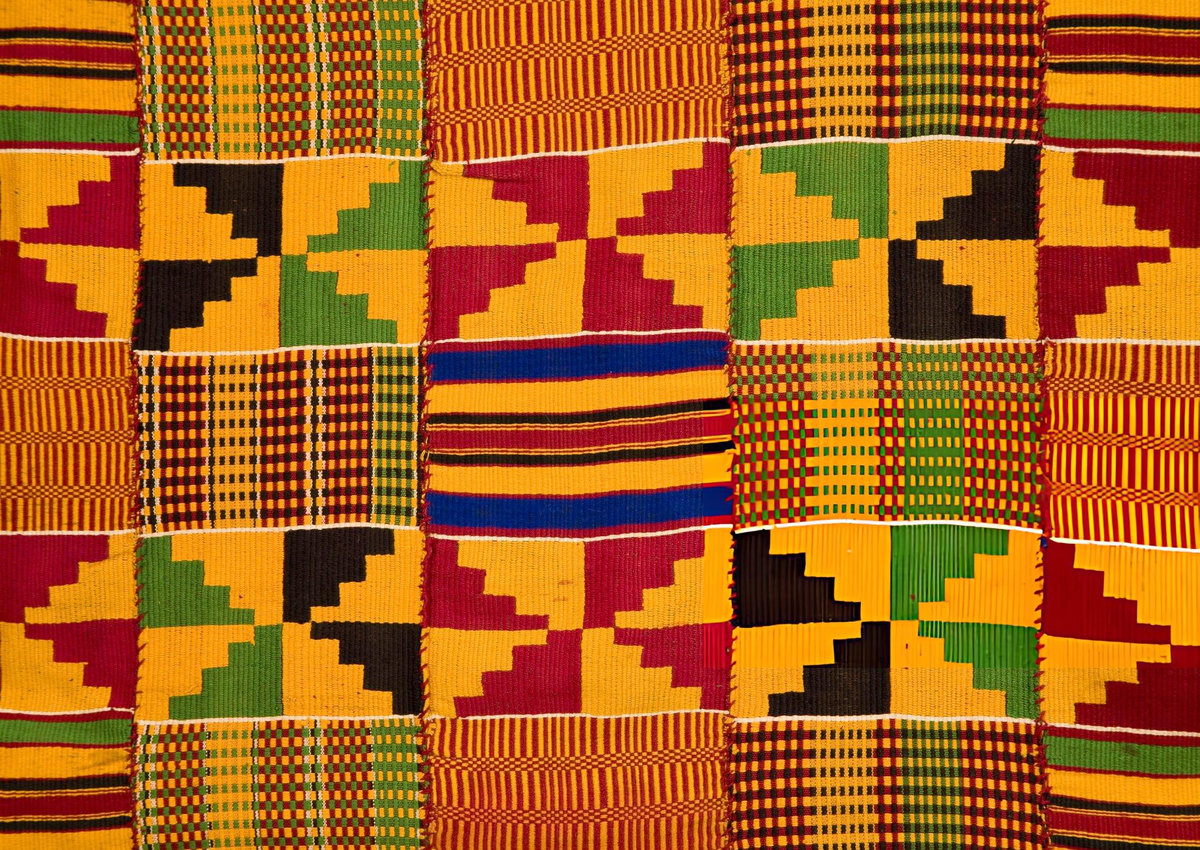
Strip weaving begins with a calculation. Before a single thread crosses the loom, the weaver must resolve the mathematical architecture of what the cloth will say. The Bonwire Kente Weaving Centre in Ghana’s Ashanti region has trained weavers across generations in precisely this discipline. Hands and feet must coordinate exactly. A misplaced treadle press reverses the weave. There is no tolerance for approximation in Kente.
Kente originates in the Ashanti and Ewe communities of Ghana. Both claim a tradition distinct in technique and design vocabulary. The dominant Asante account traces the craft to Bonwire. Oral tradition holds that two hunters, Ota Kraban and Kwaku Ameyaw, observed a spider weaving. They returned and replicated the technique in raffia. A second account names Kweku Ananse, the spider-trickster of Akan folklore, as the first teacher. What is verifiable is Bonwire’s institutional standing. The village is the seat of the Kentehenes, traditional authorities charged with oversight of Kente matters. They are the direct successors of the tradition’s founding weavers. The Ewe people of the Volta region developed a parallel and distinct tradition, with different strip structures and pattern meanings. Ghana received formal recognition of Kente from the United Nations Educational, Scientific and Cultural Organization (UNESCO) in December 2024. It was the country’s first inscription on the Intangible Cultural Heritage of Humanity list.
The Kente loom can extend to 200 feet or longer. Narrow strips are woven separately and later assembled into the finished cloth. Every skill is acquired progressively — observation, imitation, supervised practice under a master. Knowledge flows primarily through family elders, embedded in the upbringing of children in weaving communities. Professor Kofi Anyidoho is a literary scholar and trained weaver, raised by his uncle Dumega Kwadzovi Anyidoho — acknowledged as one of the most experienced master weavers in Wheta, with more than 65 years at the loom.
Free weekly newsletter
Get every new story directly in your inbox.
Craft Heritage features of artisan traditions — and the pressures they face — delivered free.
In his essay “Ghanaian Kente: Cloth and Song,” Anyidoho synthesises what that teaching revealed: “Weaving is more than the application of a sense of rhythm. It requires considerable technical skills in design, possible only through a careful application of mathematical calculations combined with the architectural ability to construct organic shapes and forms from individual threads as building blocks. This process is not unlike that involved in the architectural design of the well-made song or poem.” Mastery is legible in the finished cloth itself — its weight, compactness, and the evenness of each beaten weft a record of the hand that produced it.
Each Kente pattern carries a name. Each name references a proverb, a social situation, or a historical moment. Dr. Gifty Afua Benson, lead curator of The Legend of Kente touring exhibition, describes the tradition as “a non-verbal way of communication, with each of the hundreds of patterns having its own name.” The implications are most visible in one cloth. “Fathia” was created to honour Fathia Nkrumah, wife of Ghana’s first president. After the 1966 coup that overthrew Kwame Nkrumah, the pattern did not disappear. Two new names were coined: “One head does not form a committee,” and “One man cannot rule a nation alone.” A textile had absorbed a political reversal and revised its own meaning. Kwasi Asare, a master weaver who has exhibited at the United Nations General Assembly, frames the tradition’s creative purpose: “When students create Kente cloth, they visualize the symbolism and meaning they want to express in their fabric, which is something that can be very fulfilling, inspiring and illuminating.”
The tradition now faces a specific pressure. Cheap machine-printed cloth, manufactured primarily in China, enters Ghanaian and diaspora markets carrying Kente patterns without Kente knowledge. Responses within Bonwire are divided. Researcher Henry Boateng’s fieldwork found some traditional weavers regarding cheap imitations as “good publicity” for the authentic original — while others found the competition difficult to absorb. The December 2024 UNESCO inscription formalises what Bonwire families have maintained across generations. Kente is a knowledge system in which making cloth and composing a poem share the same intellectual architecture. Dr. Benson’s summary is exact: “Kente speaks to us. There is a story in each cloth.” What that story contains depends on who wove it, in which community, and to mark what occasion. The pattern is never merely decoration; it is the record.