Quick Answer
Does onion juice work for hair loss? Onion juice remains unproven for hair loss. A 2002 study reported 86.9% regrowth in patients with alopecia areata, but half the participants dropped out before completion. The study received a two-out-of-five quality rating, and no replication has been conducted in 23 years.
The single trial behind viral hair loss claims
Social media posts promise dramatic hair regrowth from kitchen remedies. “Onion juice triggered full hair regrowth in 87% of patients,” wellness influencers claim. TikTok videos show twice-daily scalp applications. Beauty blogs call onion juice “nature’s hair loss cure.”
Table of Contents
These claims originate from a 2002 clinical trial. Iraqi dermatologists tested crude onion juice on patients with alopecia areata, a chronic autoimmune disorder in which the immune system attacks hair follicles, causing patchy hair loss. The condition affects about 2% of the global population. The study reported that 86.9% of patients achieved full regrowth.
23 years later, onion juice appears in no major dermatology treatment guidelines. The 2023 comprehensive alopecia areata review excludes it from recommended therapies. The 2025 Brazilian Society of Dermatology consensus also omits any mention. No pharmaceutical companies have developed onion-based treatments. The single trial remains unreplicated.
Investigation of the original research explains why: dramatic laboratory findings rarely translate into widespread clinical adoption.
Dramatic regrowth in 87% of completers – but half the patients dropped out
The 2002 Baghdad Teaching Hospital study enrolled 62 patients with patchy alopecia areata. Study authors Khalifa Sharquie and Hala Al-Obaidi divided participants into treatment and control groups.
Free weekly newsletter
Get every new investigation directly in your inbox.
Science Checks and Brand Checks across the anti-ageing industry — delivered free.
The preparation protocol was straightforward. Researchers used “Australian brown onions with high volatility,” according to the published methodology. They chopped the onions, extracted the juice using an electric blender, and stored it refrigerated. No concentration standardisation, chemical analysis, or stability testing was performed.
Both groups applied treatments twice daily for 2 months. The control group used tap water.
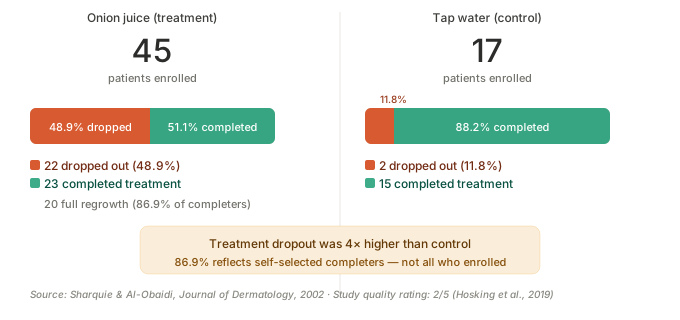
Hair regrowth began rapidly. “Hair regrowth started after just two weeks of treatment,” the authors reported. By 6 weeks, 20 of the 23 patients who completed treatment showed full regrowth. This represented 86.9% efficacy.
The authors compared their findings favourably with established treatments. “Onion juice had therapeutic effect comparable to BCG immunotherapy at 69% and topical immunotherapy at 58%,” they wrote. BCG—Bacillus Calmette-Guérin—uses bacteria to trigger immune responses.
However, the mechanism remained unclear. “The mechanism of action of crude onion juice in the treatment of alopecia areata is difficult to explain,” Sharquie and Al-Obaidi acknowledged.
They proposed two possibilities. First, antigenic competition—a mechanism in which an irritant substance causes inflammation that distracts the immune system from attacking hair follicles, potentially allowing regrowth. Second, direct irritant contact dermatitis from the sulphur and phenolic compounds in onion.
The irritant effect was observable. Fourteen of the 23 patients who completed treatment—60.8%—developed mild skin reddening during treatment.
The 49% dropout rate that calls results into question
The completion data indicate significant complications. The original onion juice group included 45 patients. During follow-up, 22 patients dropped out for unknown reasons, representing a 48.9% dropout rate. The control group began with 17 patients, with only 2 dropping out—an 11.8% dropout rate. This fourfold difference suggests severe selection bias. Patients who found onion juice intolerable, ineffective, or inconvenient likely left the study early. The reported 86.9% success rate therefore reflects only self-selected completers, not the broader patient population who began the trial.
“Some patients disliked the unpleasant odour of the treatment,” the authors noted. The distinctive smell created practical challenges. It also made true blinding impossible.
The 2019 systematic review by Hosking assigned the study a quality rating of two out of five. Reviewers categorised it as a “well-designed controlled trial without randomisation.” The review authors explained that this rating reflects significant methodological limitations, including the lack of random assignment to treatment groups. The high dropout rate raises additional concerns about the reliability of the results.
The study used tap water as the control treatment, which is a questionable placebo choice. The unmistakable onion odour made it obvious to participants which group they were in. This failure of blinding potentially introduced expectation bias, where believing a treatment works influences perceived results.
Twenty-three years later, still no replication or clinical adoption
No large-scale replication has been conducted 23 years after the original publication. Several factors account for this gap.
There are no commercial incentives. Crude onion juice cannot be patented, so companies have no financial motivation to fund rigorous trials. The distinctive odour prevents proper blinding in clinical studies. Lack of standardisation makes consistent dosing impossible. The messy application process discourages patient compliance over extended periods.
The study’s scope was limited to one specific condition. Alopecia areata is an autoimmune disorder, distinct from other types of hair loss. The findings do not apply to androgenetic alopecia—male and female pattern baldness—which affects far more people.
Onion juice remains an intriguing but unproven alternative treatment. The single methodologically limited study still awaits replication with larger samples, proper blinding, standardised preparations, objective outcome measures, and, critically, adequate participant retention to avoid selection bias that may have inflated the original success rate.
Does onion juice actually work for hair loss?
One 2002 study reported 86.9% regrowth in alopecia areata patients, but systematic reviewers rated the study two out of five for poor methodology, and no large randomised trials have replicated these results in 23 years. Current scientific consensus maintains onion juice remains unproven for hair loss.
Why hasn’t onion juice become a standard treatment if the study showed 87% success?
The original study was never replicated despite 23 years passing. It had major flaws: no randomisation, unstandardised preparation, and impossible blinding due to the unpleasant odour. Crude onion juice also cannot be patented, giving companies no financial incentive to fund expensive clinical trials.
What type of hair loss was tested in the onion juice study?
The study tested only patchy alopecia areata — an autoimmune disorder where the immune system attacks hair follicles. This is distinct from androgenetic alopecia, the common pattern baldness affecting most people. The findings do not apply to other hair loss types.
What were the major problems with the onion juice study?
The treatment group had a 48.9% dropout rate versus only 11.8% in controls, suggesting severe selection bias. The crude onion juice lacked concentration standardisation. The distinctive smell made true blinding impossible. Systematic reviewers assigned the study a quality rating of two out of five.
How does onion juice compare to proven hair loss treatments?
Onion juice cannot be reliably compared to proven treatments like minoxidil or finasteride, which have FDA approval and multiple randomised trials. Rosemary oil showed non-inferiority to 2% minoxidil for androgenetic alopecia in a randomised trial. Dermatologists recommend established options with more published data first.
Sources & References
This investigation references peer-reviewed studies from dermatology journals, systematic reviews of complementary treatments, and current clinical practice guidelines. All sources represent the highest available evidence on onion juice for hair loss.
- Sharquie, K. E., & Al-Obaidi, H. K. (2002). Onion juice (Allium cepa L.), a new topical treatment for alopecia areata. Journal of Dermatology, 29(6), 343-346. Available at: https://onlinelibrary.wiley.com/doi/abs/10.1111/j.1346-8138.2002.tb00277.x
- Hosking, A. M., Juhász, M., & Atanaskova Mesinkovska, N. (2019). Complementary and alternative treatments for alopecia: A comprehensive review. Skin Appendage Disorders, 5(2), 72-89. Available at: https://karger.com/sad/article/5/2/72/238120/Complementary-and-Alternative-Treatments-for
- Pratt, C. H., King, L. E., Messenger, A. G., Christiano, A. M., & Sundberg, J. P. (2017). Alopecia areata. Nature Reviews Disease Primers, 3, 17011. Available at: https://www.nature.com/articles/nrdp.2017.11
- Ahmed, N. S. S., Gindi, S. M. E., Bakry, O. A., Attallah, D. A., & Khairy, A. (2023). Alopecia areata: A comprehensive review. Journal of Cosmetic Dermatology, 22(7), 1947-1958. Available at: https://journals.sagepub.com/doi/10.1177/12034754231168839
- Trüeb, R. M., Dutra Rezende, H., Gavazzoni Dias, M. F. R., et al. (2025). II Consensus of the Brazilian Society of Dermatology on the diagnosis and treatment of alopecia areata. Anais Brasileiros de Dermatologia, 99(3), 377-407. Available at: https://www.anaisdedermatologia.org.br/pt-ii-consensus-brazilian-society-dermatology-articulo-S0365059624002277
- Panahi, Y., Taghizadeh, M., Marzony, E. T., & Sahebkar, A. (2015). Rosemary oil vs minoxidil 2% for the treatment of androgenetic alopecia: A randomized comparative trial. SKINmed, 13(1), 15-21.