Quick Answer
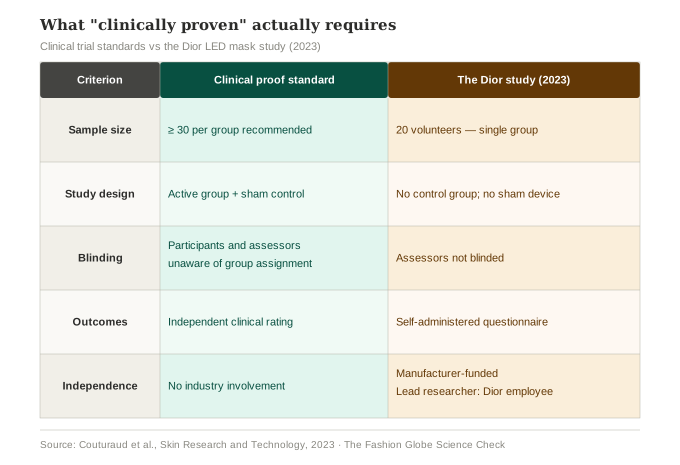
Do luxury red light therapy masks deliver the ‘clinically proven’ anti-ageing results promised by their marketing? The most prominent supporting study involved just 20 volunteers and lacked a control group, making definitive clinical proof impossible.
In 2024, red light therapy masks generated more than 70 million TikTok views, according to a peer-reviewed audit of the field. Consumers are strapping LED masks to their faces in pursuit of flawless skin. Devices cost anywhere from £100 to over £3,500.
Behind these steep prices, brands promise to erase wrinkles and rejuvenate ageing skin. One 2023 study by Christian Dior sits at the centre of the most expensive claims. The same pattern appears in No7’s Future Renew serum, which relies on a single manufacturer-funded trial to support its ‘97% saw a difference’ claim.
The underlying science is photobiomodulation: the use of specific light wavelengths to trigger biological changes in skin tissue. The question is whether a single manufacturer-funded study of 20 volunteers can carry the weight of the phrase “clinically proven.”
Table of Contents
What the Dior study actually found
In June 2023, Skin Research and Technology published a study on the Skin Light Dior mask. Its lead researcher, Virginie Couturaud, is employed by Christian Dior. The brand retails the device for €4,000 and calls its results “clinically proven.”
The study recruited 20 healthy volunteers — 15 women and five men — aged between 45 and 70. However, the paper’s own abstract describes the sample as “20 healthy Caucasian women.” Participants used the device twice weekly for three months, at 12 minutes per session.
Eight outcomes were measured using specific clinical instruments. Skin firmness was assessed using a Cutometer, a device that measures the mechanical properties of skin. Dermal density was assessed by ultrasound, complexion evenness by chromametry (an instrument that measures skin colour and tone), and pore diameter by macrophotography.
The remaining measures — crow’s feet depth, facial sagging, skin roughness and sebum levels — were scored clinically or by instrument. Volunteer satisfaction was assessed via self-administered questionnaire at the study’s end.
After three months, the researchers recorded a 38.3% decrease in crow’s feet depth and a 47.7% increase in dermal density. Skin firmness, measured by the R0 value, decreased by 23.6%. Sebum measurements were conducted on only ten of the 20 volunteers: those presenting with mixed to oily skin.
The researchers concluded that these results “confirm the interest of using photobiomodulation to reverse the visible signs of aging.” Improvements persisting one month after stopping were described as “a sign of lasting structural and functional rejuvenation of the skin.”
How to read a ‘clinically proven’ claim
The phrase ‘clinically proven’ carries a specific meaning in medical research. It implies, at minimum, two groups: one receiving the active treatment, one receiving a sham equivalent. The Dior study contained none of these elements — no control group, no sham device.
The study was conducted by Dior’s own employee on Dior’s own commercial product. Co-author Frederic Granotier is affiliated with Lucibel Group, the manufacturer of the tested device. The conflict of interest statement declares no competing interests.
Without a comparison group, there is no way to separate the effects of red light from the placebo effect. The placebo effect describes the documented tendency for participants to report improvement simply from believing a treatment is working. An expensive device used consistently over several months is precisely the kind of intervention where expectation alone can generate reported results.
This missing baseline is exactly what Dr David Robert Grimes identified in his 2025 independent audit. As a radiation physicist at Trinity College Dublin, he highlighted the Dior research’s lack of a non-light control group.
The problem extends well beyond one luxury brand. Grimes found that one third of all visible light studies lacked a control group entirely. Assessors often knew which patients received the treatment, introducing severe experimental bias. The same divergence between industry-funded and independent research has built the collagen supplements market.
Grimes also exposed a deeper problem with dosage. The studies he reviewed used wavelengths and treatment times that differed wildly. No studies reported any dose validation, making it impossible for other scientists to replicate the findings.
What a sham-controlled trial actually found
In February 2025, a multi-centre South Korean trial applied the design the Dior study lacked. It was double-blind and sham-controlled — meaning neither participants nor assessors knew who received the active device. Half the 60 participants were assigned a mask that appeared identical but emitted minimal light.
Independent raters assessed outcomes without knowing which group each participant belonged to. They recorded an 86.2% improvement rate in the active group — a 69.5% difference against the sham control.
Yet this successful protocol was significantly more intensive than the twice-weekly Dior routine. Participants used the Korean device five times a week for 12 weeks.
| Dior / Couturaud 2023 | Park et al. 2025 | |
|---|---|---|
| Sample size | 20 | 60 (59 analysed) |
| Control design | No control group | Double-blind sham device |
| Session frequency | 2 × weekly | 5 × weekly |
| Outcome assessment | Self-questionnaire | Independent raters |
In late 2025, the Advertising Standards Authority banned four LED mask brands for making unlawful medical claims. Britain’s medical device regulator, the Medicines and Healthcare products Regulatory Agency (MHRA), had no LED face masks on its public registration database — a finding confirmed by a BBC investigation that month. These enforcement actions reflect the commercial architecture that makes unsubstantiated claims profitable regardless of the evidence base.
The reality of home light therapy
The independent expert consensus is not that red light therapy is fraudulent. It is that the claims attached to consumer masks go far beyond what the science currently supports.
Dr Justine Kluk, a consultant dermatologist and British Skin Foundation spokesperson, identified precisely where the evidence breaks down. “There is even less data available for at-home LED masks for treating these skin conditions,” she told The Independent, “and out of the handful of studies they are published by the companies that sell them, so there is bias in interpreting the results — they probably wouldn’t publish data that showed they didn’t work.”
Dr Jonathan Kentley, also a British Skin Foundation spokesperson, drew the line at the specific claim this article investigates. He stated there is “insufficient evidence” to claim at-home LED masks reduce wrinkles. That conclusion sits in direct contradiction to a product page calling the same category “clinically proven.”
Dr Daniel Barolet, a photobiomodulation researcher at McGill University and a proponent of the underlying science, acknowledged “a lot of hype in the industry.” He noted that scientists are still refining the ideal wavelength, intensity and proximity for each health goal. His estimate for cumulative visible results on normally ageing skin: five to ten years of consistent use.
The science of light therapy is real, but the consumer evidence remains fractured. A single uncontrolled study of 20 volunteers cannot prove lasting structural rejuvenation. Until brands fund independent, sham-controlled trials, “clinically proven” remains a marketing slogan rather than a scientific fact.
Are red light therapy masks clinically proven to work?
The phrase “clinically proven” in red light mask marketing refers primarily to a single 2023 study funded by Parfum Christian Dior, conducted on 20 volunteers without a control group. Without a comparison group, there is no way to separate the device’s effect from the placebo effect. Independent experts at the British Skin Foundation state there is “insufficient evidence” to claim at-home LED masks reduce wrinkles. The standard scientific threshold for a “clinically proven” claim requires, at minimum, a double-blind, sham-controlled trial.
What does “clinically proven” actually mean in scientific research?
In rigorous medical research, “clinically proven” implies a study design with at least two groups: one receiving the active treatment and one receiving a sham equivalent — an identical-looking device that does not emit the active wavelength. This design separates genuine treatment effects from expectation-driven improvements. The Dior study contained neither a control group nor a sham device, meaning its results cannot support a “clinically proven” claim by standard scientific criteria. A 2025 South Korean trial applied this design correctly and produced results that can be meaningfully attributed to the device.
Do at-home LED masks have any scientific evidence behind them?
The underlying science — photobiomodulation, the use of specific light wavelengths to trigger biological changes in skin tissue — is real and studied in clinical settings. A 2025 South Korean sham-controlled trial found an 86.2% improvement rate in the active group, 69.5% above the sham control. However, that protocol required five sessions per week for 12 weeks — considerably more intensive than the twice-weekly routines most consumer masks prescribe. The evidence for at-home devices operating at lower frequencies and intensities remains limited.
Are LED face masks regulated as medical devices in the UK?
As of late 2025, the Medicines and Healthcare products Regulatory Agency (MHRA) had no LED face masks on its public registration database, as confirmed by a BBC investigation. The Advertising Standards Authority banned four LED mask brands in late 2025 for making unlawful medical claims. Without formal medical device classification, LED masks are not subject to the clinical evidence requirements that apply to regulated medical devices — meaning brands can market them without producing independently verified proof of efficacy.
How can I evaluate whether an LED mask study is reliable?
Four questions can help assess any LED mask study. First, who funded it? Manufacturer-funded research has a documented pattern of finding positive results that independent research does not replicate. Second, was there a control group or sham device? Without one, it is impossible to separate the device effect from expectation. Third, how many participants were enrolled? Studies with fewer than 30 participants in each group have limited statistical power. Fourth, were outcomes assessed independently, or by self-reported questionnaire? Independent rater assessment is the more reliable standard.
How long would I need to use an LED mask to see results?
The most robust sham-controlled trial — the 2025 South Korean study — used five sessions per week over 12 weeks before measurable results were recorded. The Dior study used a twice-weekly protocol over three months, though without a control group its results cannot be attributed to the device alone. Dr Daniel Barolet, a photobiomodulation researcher at McGill University, estimates five to ten years of consistent use for cumulative visible results on normally ageing skin — a figure well beyond what most consumer marketing implies.