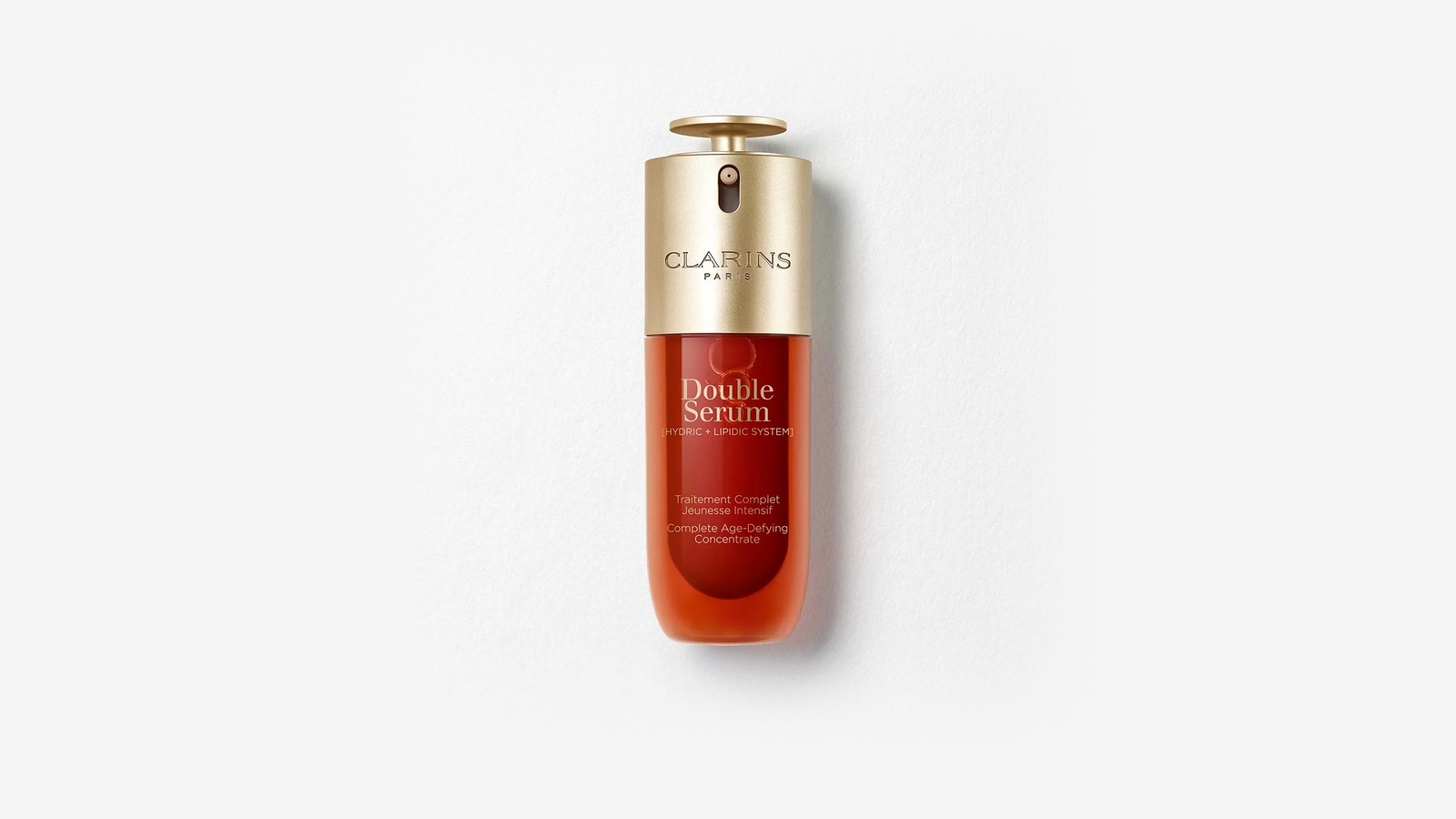
Clarins has relevant human evidence behind its Organic Harungana–retinol comparison. But the study used cream-base formulations rather than the finished Double Serum, and its findings are narrower than the product-page wording suggests.
Clarins places a striking comparison at the heart of its Double Serum product page: its Organic Harungana extract is described as “as effective as retinol”.
On its US product page, Clarins says:
“Exclusive Organic Harungana* extract, as effective as retinol,⁵ + Peptides help renew for visibly firmer, smoother, plumper skin.”
A shopper could reasonably read this as a comparison between Double Serum itself and a retinol product, but the footnote is more specific:
“Comparative clinical study carried out on the anti-wrinkle and smoothing efficacy on 46 women who applied a base containing either Organic Harungana extract, or retinol, with a % percent of ingredients identical to that of the finished product for a period of 56 days.”
Free weekly newsletter
Get every new investigation directly in your inbox.
Science Checks and Brand Checks across the anti-ageing industry — delivered free.
The claim relates to anti-wrinkle and smoothing efficacy and comes from a 56-day comparison involving 46 women. The footnote does not cover every benefit commonly associated with retinol.
A 2023 study by Gibielle and colleagues closely matches several important parts of the footnote.
It was a randomised, double-blind comparative study involving 46 women. The study ran for 56 days after a 14-day washout period. Assessments took place at the start and after 28 and 56 days. Participants used the two formulations on opposite sides of the face.
One formulation contained Harungana madagascariensis extract and the other contained retinol. The study reported similar effects on the tested anti-ageing outcomes, including wrinkle-related and skin-smoothness measures.
Clarins funded the research, and several authors were Clarins employees. Those disclosures do not, in themselves, determine the value of the findings.
The study compared two formulations made with a neutral oil-in-water cream base. One contained 0.02% dry Harungana extract by weight, and the other contained 0.05% retinol.
The creams tested were not Clarins Double Serum.
The comparison provides relevant evidence for Harungana and retinol under those test conditions, but it does not directly establish how finished Double Serum compares with a retinol product.
Clarins’ footnote states that the base contained an ingredient percentage identical to that of the finished product. Double Serum’s concentrations are not publicly documented in the research record, so the link between the tested cream and the serum remains unclear.
“As effective as retinol” can sound as though the two have been shown to work equally well, yet the available research record did not identify a formal equivalence or non-inferiority framework.
The study reported similar or comparable effects, but that is not the same as a formal finding of equivalence, which requires a study specifically designed to answer that question.
Clarins’ product sentence also refers to visibly firmer, smoother and plumper skin, and mentions peptides alongside Harungana.
The Harungana–retinol footnote specifically concerns anti-wrinkle and smoothing efficacy. The comparison should not automatically extend to firmness, plumping, radiance, pores, rapid results or any other benefit associated with Double Serum or retinol.
Laboratory research also helps explain the biological basis for the Harungana–retinol comparison. A separate 2022 study by Fitoussi and colleagues examined the extract in fibroblasts and skin explants.
But this was mechanistic research, not a consumer-use clinical study. It adds biological plausibility, but does not establish visible performance for finished Double Serum or show that consumers would get the same results as they would from retinol.
The clearest reading is a narrow one: the study found similar or comparable anti-wrinkle and smoothing effects under the tested cream-base conditions.
That is narrower than the likely consumer-facing meaning of “as effective as retinol”, and it does not establish that the finished Double Serum itself performs like a retinol product.