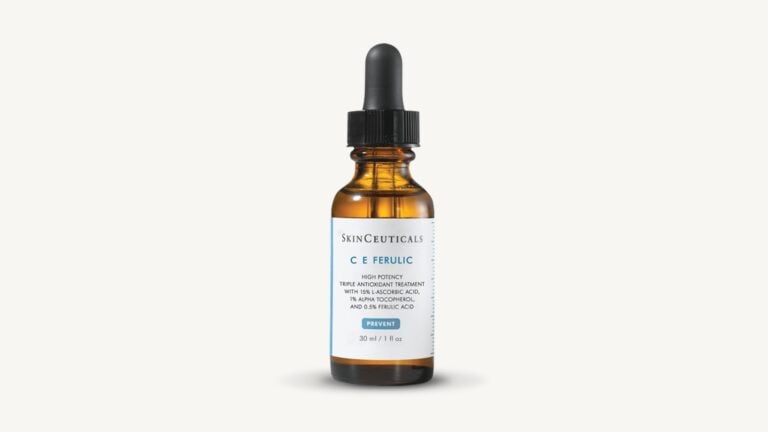
A skincare product can keep its name while its formula changes. For SkinCeuticals C E Ferulic, that distinction matters when judging the research behind the bottle.
In July 2026, SkinCeuticals announced a next-generation C E Ferulic. The antioxidant serum would retain its vitamin C, vitamin E and ferulic acid base, with two additions: carnosine and an ingredient the company calls Endophytol™. The announcement also invoked more than 20 years of research and over 30 peer-reviewed publications.
There is documented experimental work behind that history. A 2008 study tested a formula historically associated with C E Ferulic on human skin. Researchers applied it to one area and a comparison preparation to another before exposing the skin to simulated sunlight. This was an experiment on a defined formula, rather than simply a paper mentioning the serum or discussing one of its ingredients.
The 2008 study identifies the three antioxidants and their concentrations, but the material reviewed does not establish the formula’s complete composition. Keeping the original three ingredients at the same stated concentrations does not, by itself, establish how the reformulated serum performs. And the material reviewed by FG does not establish which of these formulations corresponds to the exact version currently sold in the United States.
The serum’s reputation also comes with competing research counts. A Veriphy Skincare blog article describes C E Ferulic as “referenced in over 100 peer-reviewed studies.” That is a third-party description, distinct from SkinCeuticals’ own figure of over 30 publications. Neither source supplies the publication list and counting method needed to explain the difference. Being referenced in a paper does not necessarily mean being tested in it.
C E Ferulic has a documented research history. What the supplied evidence cannot establish is how much of that history directly supports the exact serum a U.S. customer would buy today. A product name can carry a reputation across generations; each experiment remains evidence about the formula it actually tested.
Read full analysis
What was in the study formula?
The 2008 human-skin experiment used a formula called CEFer containing 15% L-ascorbic acid, 1% alpha-tocopherol and 0.5% ferulic acid. L-ascorbic acid and alpha-tocopherol are the forms of vitamin C and vitamin E used in that preparation.
Researchers compared it with a vehicle—the comparison preparation used in the experiment—before solar-simulated ultraviolet exposure. The study provides direct experimental evidence concerning that defined formulation under those conditions. Although the formula has a documented historical association with C E Ferulic, the study does not identify a particular retail bottle, manufacturing lot or complete commercial formula.
The 2026 announcement retains those three stated concentrations and adds 0.3% carnosine and 1% Endophytol™. The material reviewed does not establish the link between either described formula and the exact current U.S. retail version.
Why the publication counts cannot be compared
Veriphy’s wording leaves “referenced” undefined. Without its publication list, FG cannot determine whether the total includes direct product experiments, studies of earlier formulas, ingredient research, citations or some combination of these.
SkinCeuticals’ figure of over 30 peer-reviewed publications also lacks an accompanying list and counting method in the material reviewed. The two totals therefore cannot be treated as equivalent measures—or reconciled simply by comparing the numbers.
The sources make different claims about the serum’s standing, too. Veriphy places it among the most researched products across the skincare industry. SkinCeuticals claims the most extensive body of clinical evidence within the narrower category of topical antioxidant serums. Neither comparison is established by the comparative evidence supplied.
What this check establishes
FG compared the third-party description, SkinCeuticals’ announcement and the published human-skin study. Together, they establish a historical formulation experiment, an announced formula change and research-volume claims whose underlying counts remain unexplained.
They do not establish the performance of the exact current U.S. product. That is the boundary of this check, rather than a finding that the reformulated serum performs better or worse.