
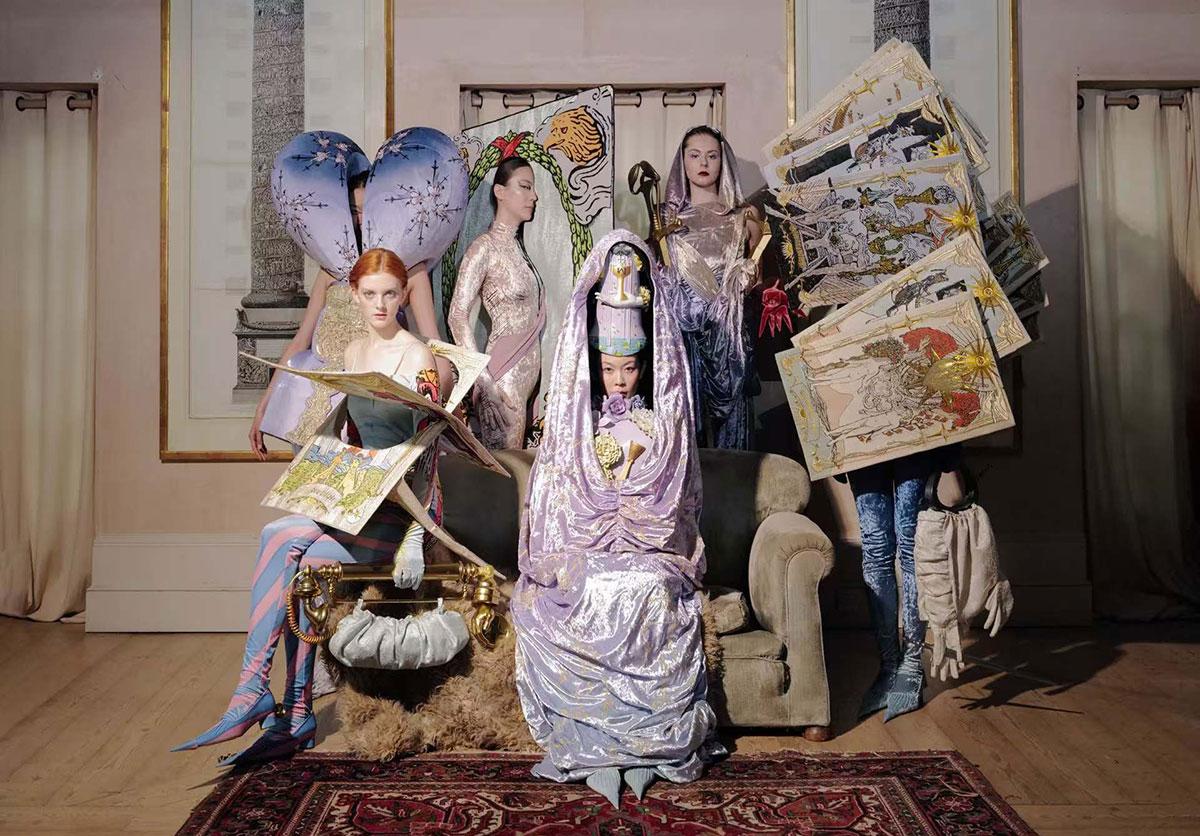
At a time when personal identity feels increasingly fragmented, a compelling new approach to fashion is emerging that sees clothing as far more than just an aesthetic expression. This exploration of the “embodied tarot” shows how garments can serve as vessels for our deepest emotional states, fundamentally transforming the relationship between what we wear and who we are.
Shadow Eclipse represents an exploration of Gao Ziting’s design approach, examining the relationship between garment construction and narrative, materiality, and perception. Developed as the final project of her undergraduate programme, the collection emphasises structural reconfiguration and sensorial intervention, exploring tension and resonance between form and feeling.
Characterised by asymmetrical silhouettes and obscured bodily structures, the looks present a commentary on the fragmented identity of the modern subject within sociocultural systems.
“Tarot, to me, is more than a tool of divination. It’s an emotional vessel, a way of externalising the tension between uncertainty and hope,” says Gao. This conceptual framework runs throughout the collection, from its initial development to its spatial execution. Drawing from the four elemental archetypes of tarot—air, fire, water, and earth—each ensemble functions as an embodied tarot card, incorporating symbolic resonance and emotional subtext. The garments serve as vessels of psychic projection, transmitting layered internal states through visual allegory.

Gao demonstrates a considered approach to texture and mood in her material choices. High-saturation velvets, paper-like textiles with raised tactility, intentionally distressed satin, and expanses of hand-stitched metallic thread combine to create an intense tactile-emotional field. Her use of chromatic layering, combined with asymmetrical panelling and gold thread embroidery, establishes a visual dialogue between instability and control. In Gao’s approach, clothing functions not merely as an extension of the body, but as a sculptural language of emotional architecture.
What characterises Shadow Eclipse is the precision with which it balances experimentation and craftsmanship. Several key looks are developed through extended silhouettes, enveloping headpieces, and handheld sculptural extensions, creating a performative visual arena. Beneath this theatricality lies technical execution—meticulous seam construction, reinforced internal scaffolding, and hand-pleated treatments—demonstrating Gao’s ability to combine innovation with artisanal technique. The garments function as immersive environments—multisensory narratives that invite affective engagement.

Her design references extend beyond semiotic systems to engage with fashion’s historical discourse on clothing as a mnemonic device.
Echoing Hussein Chalayan’s After Words, where furniture becomes a wearable artefact, and Iris van Herpen’s translation of digital illusion into kinetic couture, Gao creates a visual leap from symbolic text to embodied structure. Tarot card folds become modular frameworks; garments transform into carriers of coded meaning. Through a deconstructivist arrangement of motifs, she develops new formats for spiritual containment—hovering between disorder and form.
Recognised among the notable graduates of the class of 2025, Gao Ziting articulates her design approach in Shadow Eclipse: positioning garments as conduits for embodied psychological experience, constructing layered emotional narratives through textile, structure, and spatial composition. The graduate showcase attracted an international audience of industry professionals, fashion media, and creative institutions. Gao’s collection received attention from independent buying platforms, concept retailers, and cross-disciplinary art-fashion publications.
Her exploration of the ‘unfinished body’ and perceptual structures highlights both an artistic vision and potential for commercial application—indicating possibilities for brand development, product line expansion, and broader recognition.

Shadow Eclipse examines conventional understandings of fashion not merely as a stylistic gesture but as an interweaving of symbolic systems, cultural memory, and subjective reality. In Gao Ziting’s work, garments become collages of belief and the subconscious—site-specific rituals in cloth, presenting an inquiry into how selfhood is continuously reconstructed at the threshold of mysticism and materiality.