
Editor’s Note: In contemporary fashion, cultural identity often becomes trapped within rigid symbols and visual clichés. Designer Alimujiang Adili offers a different path, one that favours softness over assertion and silence over spectacle. His work asks a vital question: when culture, emotion, and craft are freed from fixed forms, what new possibilities emerge?
In Alimujiang Adili’s work, culture, emotion and artisanal memory intersect through a measured approach. He avoids emphasising identity through ethnic symbols as visual shortcuts, instead examining how culture manifests in contemporary fashion, particularly whether it can exist in alternative forms after being symbolised and exoticised.
White Flame (2020) marks the starting point of his exploration into a ‘neo-ethnic’ aesthetic. Inspired by the Dola tribe, his approach favours ‘fading’ over appropriation: the vibrant traditional colours and patterns are stripped away, leaving behind cool whites, soft light, and minimalist linear structures. Here, white signifies not absence but a gesture of emptying, allowing ethnicity to withdraw from superficial symbols and re-emerge as a reconfigurable mode of perception. Tradition no longer asserts itself through conspicuousness but reappears in a state closer to silence. The work does not display ethnicity, but questions what ethnicity might still become.

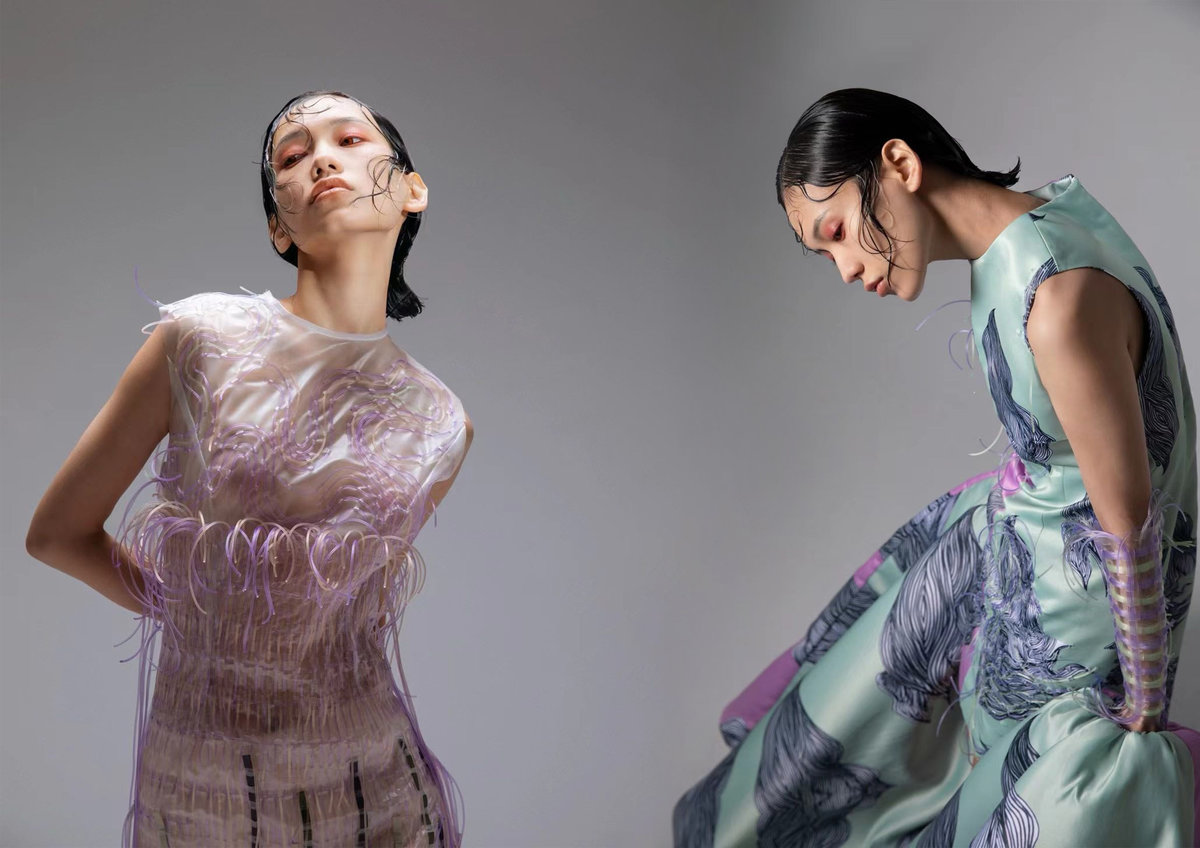
This approach continues in JEALOUS (2023), though the focus shifts from culture to emotion. In this series, he uses ‘jealousy within friendship’ as a thread, distilling the concept of envy into a structural language. He neither dramatises jealousy nor amplifies it with exaggerated visual metaphors, instead deconstructing it into more subtle ‘fluctuations’. Jealousy manifests as alpha-ray-like textures within the works, becoming persistently vibrating electrical lines within the fabric. This interacts with the cool, synthetic feel of PVC to create a texture simultaneously rational and uncontrolled. The emotion is not externalised but permeates the fabric’s internal structure, like faint echoes of inner turmoil resonating deep within the body. The work presents a contemporary perspective: emotion is not for display, but for experiencing; not amplified, but embedded.

Compared to the preceding pieces, Memory of Ghiya (2022) takes a different direction. Here, there is no emotional experimentation, no rewriting of cultural structures, but rather a narrative about craftsmanship and time. Alimujiang collaborated with an elderly artisan to revive the lost double-sided camel wool Edlesis technique using wool and pomegranate peel. Disrupting traditional pattern structures, they reconfigured the form of memory through novel layouts. The fabric became ‘unfinished’ when the artisan passed away mid-weave, transforming the work into a memorial. The piece embodies emotion woven into time, preserving elements of perseverance, loss, reverence, and connection to craft.
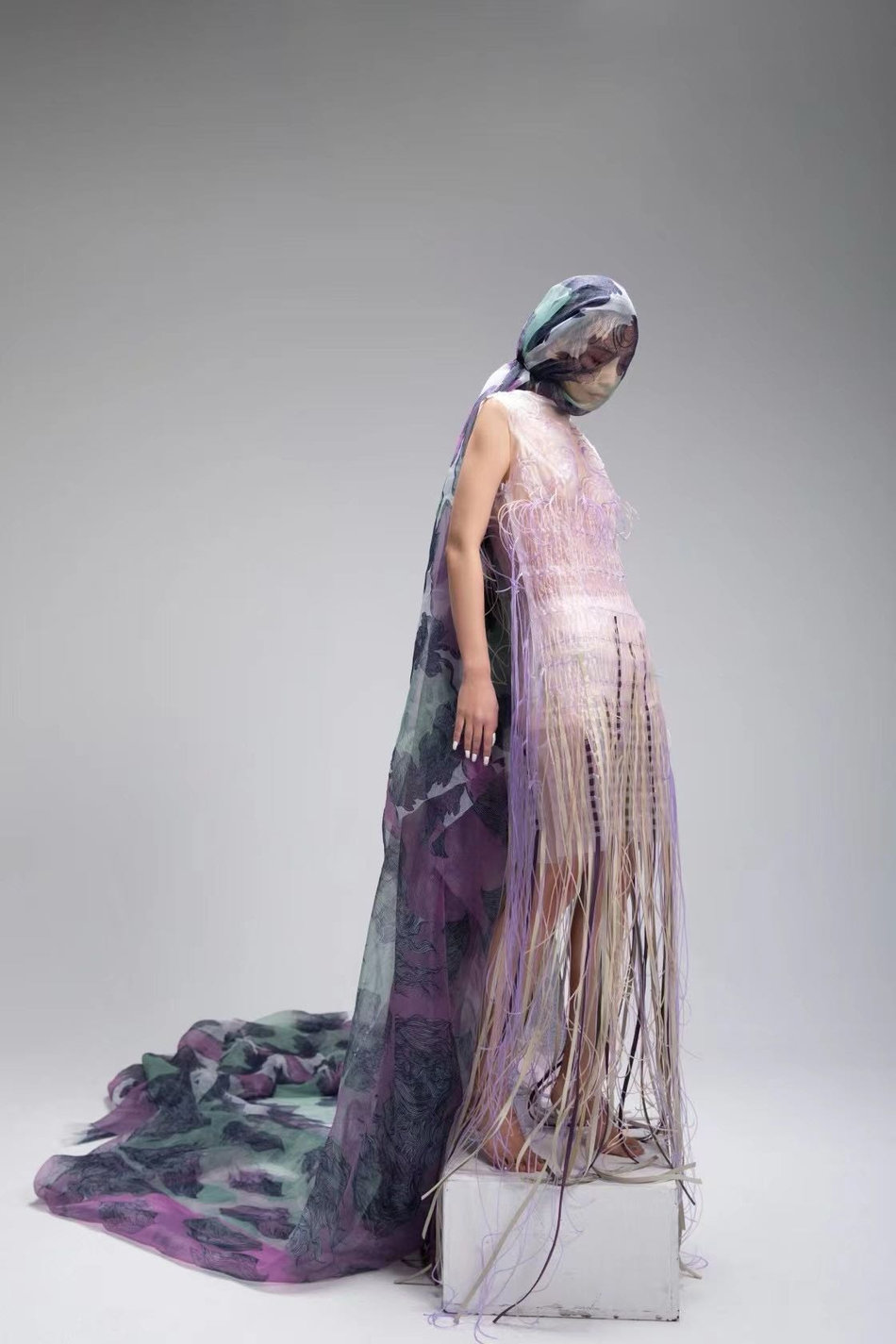
His design projects, presented sequentially, converge upon a central question: when culture, emotion, and craft no longer exist in fixed forms, how might they be re-expressed in alternative ways? In White Flame, this approach transcends rigid cultural frameworks; in JEALOUS, it refracts emotion; in Memory of Ghiya, it echoes craftsmanship. Alimujiang does not create conflict through force; he works through restraint, separating culture from fixed labels, giving texture to emotion, and transforming craft into tangible memory.
In his work, softness functions not as concession but as an alternative form of expression; not as fragility, but as a shape in development.