
For decades the rule was simple. A serious watch wore steel or it wore leather, and rubber was for the pool. That orthodoxy has quietly collapsed. Walk into a watch boutique today and you will find high-grade rubber and elastomer wrapped around timepieces that cost more than a small car, worn without apology by people who know exactly what they own. The change says less about fashion than about a material being taken seriously — and about owners realising the band is the quickest way to alter how a watch feels.
From the dive deck to the drawing room
Rubber’s claim to a luxury wrist is older than most assume. In the 1960s, the earliest dive watches left the factory not on bracelets but on perforated rubber straps — the so-called Tropic style that equipped the first Submariners and Fifty Fathoms. As the watch publication Worn & Wound has documented, those straps were standard issue on the most coveted tool watches of the era, valued for staying supple in salt water while leather rotted. What began as deep-sea necessity became, in hindsight, one of the most collected designs in watchmaking.
A material worth understanding
Not all rubber is equal, and the distinction matters more than the marketing suggests. The straps now considered acceptable on fine watches tend to be made from FKM, a fluoroelastomer first developed for aerospace and industrial sealing, where heat, chemicals and ultraviolet light see off lesser compounds. On the wrist that translates into something soft, odourless and genuinely hard-wearing, holding its colour and shape for years rather than perishing in a drawer. The idea was sealed as legitimate when Rolex introduced its Oysterflex in 2015, an elastomer band reinforced with a metal core and fitted to solid-gold models. Time+Tide has detailed how that first rubber Rolex quietly rewrote the rules. When the most conservative name in the trade puts rubber on gold, the argument is more or less over.
Where it earns its keep
The pleasure of a rubber strap is how much it changes a watch you already own. A Rolex Submariner on its bracelet is a statement of intent; the same watch on a matte black band reads looser and more modern, better suited to linen than tailoring. Specialists such as Helvetus now cut rubber straps for Rolex to exact case dimensions, so the fit looks original rather than approximate. The logic carries across the catalogue. An Omega Seamaster gains a sportier ease, an IWC Pilot sheds a little of its formality, and a Panerai — a brand built on rubber from the outset — simply returns to type. Even the MoonSwatch, the accessible Omega collaboration that pulled the whole category into the mainstream, has become a canvas for owners changing colours by the week.
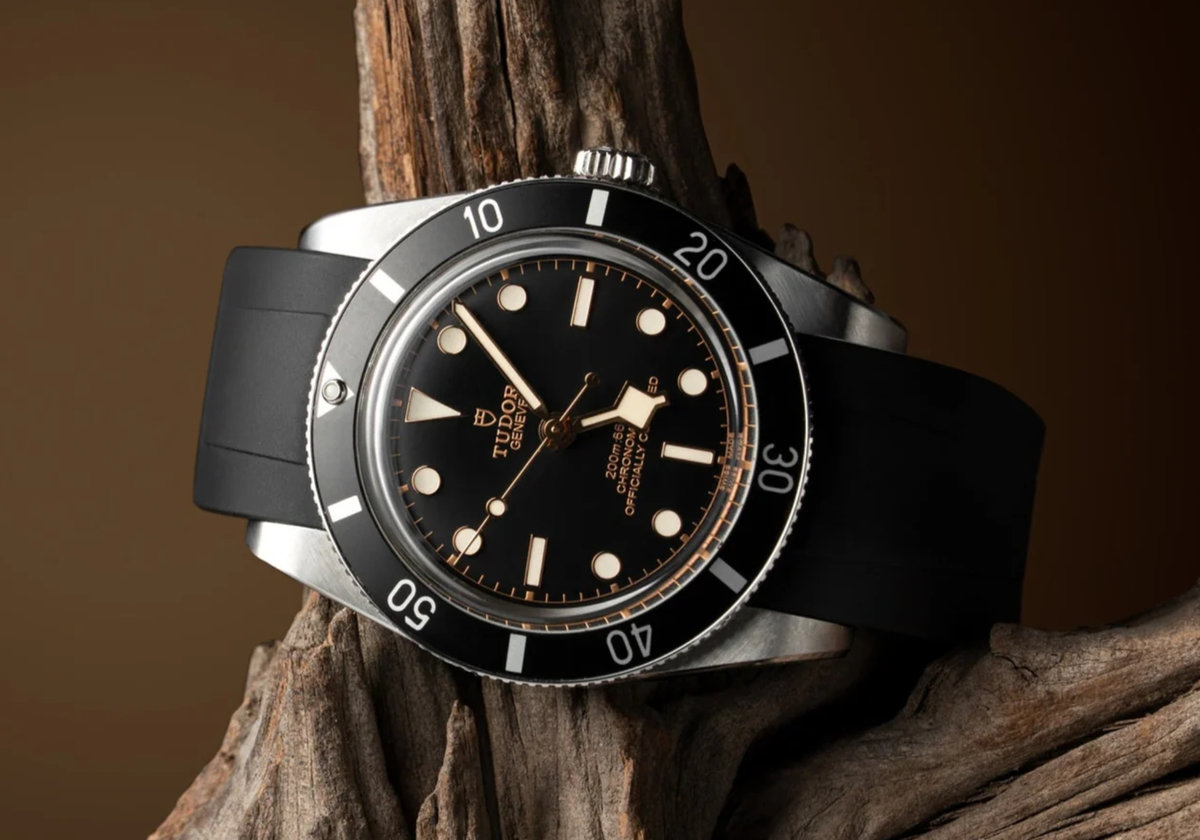
What surprises people is how well the idea travels to dress watches. A Cartier Santos, with its exposed screws and squared bezel, was always half a sports watch anyway; straps for the Cartier Santos in clean black rubber lean into that duality without coarsening the design. Tudor’s Black Bay, for its part, looks entirely at home on rubber — a nod to the dive heritage it openly borrows from.
The styling logic
For all the talk of versatility, a rubber strap still rewards a little discipline. The colour is best answered to the dial or the bezel rather than the outfit, which keeps the watch looking considered rather than costumed. A single accent — a navy line through black, say — does more than a bright band ever will. Texture counts too: a smooth, gently tapered strap dresses up far more readily than a chunky dive profile, and on a smaller watch the slimmer cut is almost always the right one. The aim is not to disguise a luxury watch as something casual, but to give it a second register, the way a good jacket works with both a shirt and a roll-neck.
None of this requires a second watch, which is rather the point. A strap costs a fraction of the timepiece it sits on, takes minutes to change, and lets a single object move between a desk, a beach and a dinner without ever feeling out of place. The watch was always the constant; the rubber strap simply turned it into something that can be quietly reorganised at will.