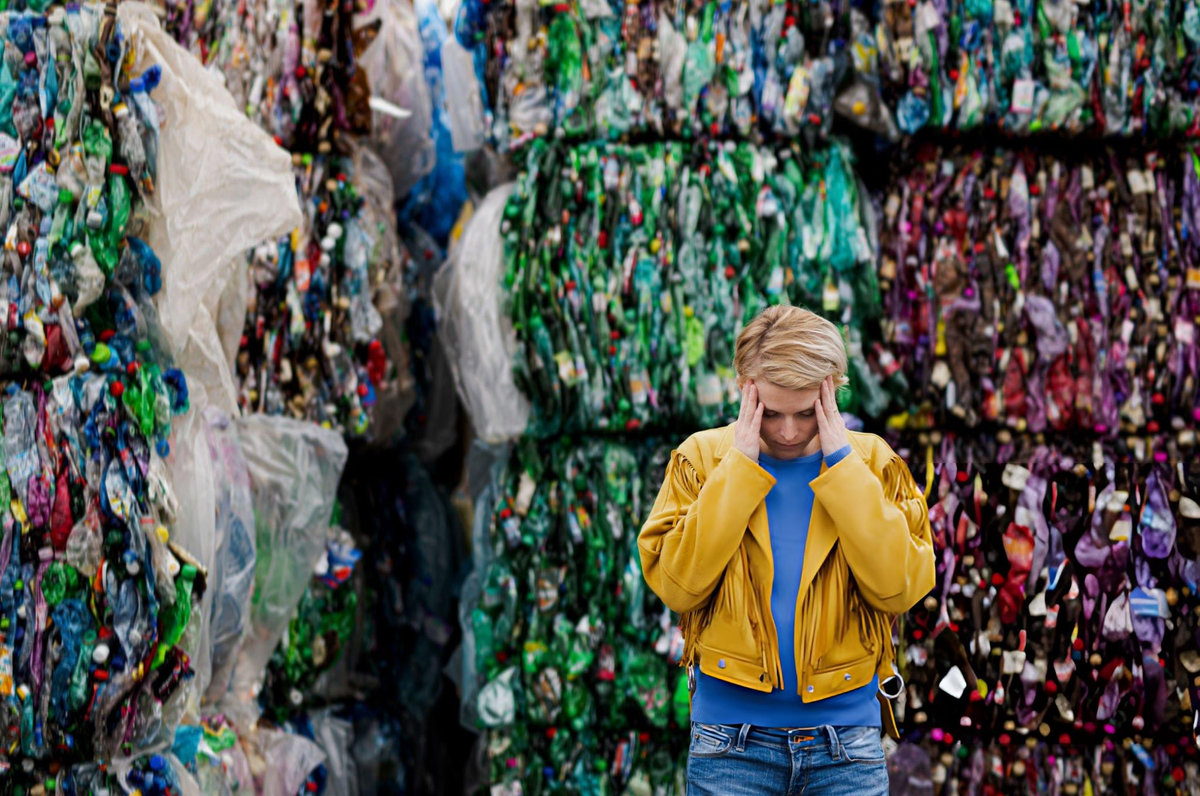
Every year, millions of tonnes of plastic bottles end up in landfills and oceans. The fashion industry proposed a solution: turn those bottles into clothes. The material is called recycled polyester, or rPET. Plastic bottles are collected, shredded, melted and spun into textile fibre. Adidas now sources 99% of its polyester this way. Nike states it diverts roughly one billion bottles from landfills and waterways each year. The marketing sounds clean: divert waste, cut carbon, wear the result.
The carbon case is real. Producing conventional polyester requires extracting and refining crude oil. Recycling bottles into fibre skips most of that energy cost. Independent analyses consistently confirm a reduction in carbon emissions at the manufacturing stage — estimates range from 18% to 50%, depending on how the full life of the garment is measured. No credible study disputes that rPET produces less carbon than virgin polyester to manufacture.
The problem begins at the washing machine.
Every time a synthetic fabric is washed, it sheds microscopic fibre fragments. These particles — too small to see — pass through wastewater filters and enter rivers, oceans and food chains. Professor Richard Thompson of the University of Plymouth, the marine biologist who coined the term “microplastics” in 2004, has warned that these are persistent contaminants. “The predictions are that we’ll see wide-scale ecological harm from the microplastics in the next 70 to 100 years,” he stated. “They’re not going to degrade.”
In December 2025, the Changing Markets Foundation published the results of laboratory testing on 51 garments from Adidas, H&M, Nike, Shein and Zara. The work was carried out by the Microplastic Research Group at Çukurova University in Turkey, led by Professor Sedat Gündoğdu and Associate Professor İlkan Özkan. Their central finding inverts the brands’ sustainability narrative. Recycled polyester sheds more than half again as many microplastic particles during washing as virgin polyester. The particles are also nearly 20% smaller — and smaller particles penetrate biological tissue more easily.
Earlier research by the same team found even higher differentials. Özkan put the implications plainly. “If you are recycling a product, you must examine it from every angle,” he stated. “The results of our studies showed that recycled polyester garments shed two to three times more fibres than conventional polyester garments. These fibres were also shorter. The shorter a fibre, the easier it can enter a living organism’s body.”
The cause is the recycling process itself. Mechanical recycling — the dominant commercial method — melts and re-extrudes plastic into new threads. Each heat cycle breaks down the internal structure of the plastic, producing fibre that fragments more readily during washing. Gündoğdu and Özkan’s research identifies this not as a side effect but as a direct consequence of how the process works.
Not all researchers agree on the scale. Dr Kelly Sheridan, chief executive of The Microfibre Consortium and an associate professor at Northumbria University, led a 2023 study testing 251 fabrics. Her team found no statistically meaningful difference in fibre fragmentation between recycled and virgin polyester. The divergence lies in method: her study tested isolated fabrics under controlled conditions, while the Çukurova team tested commercially sold garments as consumers would actually buy them. Sheridan acknowledged a significant gap in the evidence base, noting that her consortium does not yet have enough data on chemically recycled polyester to draw conclusions.
The structural problem extends beyond shedding. A plastic bottle can be recycled back into a bottle indefinitely. Once it becomes a garment, it exits that closed loop permanently. The assessment tools brands rely on to measure rPET’s sustainability — principally the Higg Materials Sustainability Index, an industry tool that measures a material’s environmental footprint — formally exclude microplastic pollution from their calculations. Textile Exchange, the body that promotes sustainable fibre adoption, has acknowledged that “impact data — and appropriate methodologies — for different recycling processes are limited.” Urska Trunk, Senior Campaign Manager at the Changing Markets Foundation, was direct about what that exclusion conceals: rPET, she stated, is “a sustainability fig leaf covering fashion’s deepening dependence on synthetic materials.”
Regulators have begun to respond. In March 2025, the Nuremberg-Fürth Regional Court ruled Adidas’s “climate neutral by 2050” claim misleading. The EU’s Directive on Empowering Consumers for the Green Transition will require verified environmental claims from September 2026.
A technically superior recycling process exists. Chemical depolymerisation breaks polyester down to its molecular building blocks and reconstructs it without the structural degradation that drives shedding. A 2025 Systemiq analysis — partly funded by textile brands and recycling technology developers — found it costs more than twice as much as virgin polyester from Asia. Less than 1% of textile waste is currently accessible for the process.
Gündoğdu framed the choice the industry now faces. “If textile circularity policies do not explicitly account for microfibre release across the full life cycle, they risk becoming green narratives rather than evidence-based interventions,” he stated. “The question is no longer ‘Should we recycle?’ The question is ‘How much environmental harm are we willing to ignore in the name of circularity?'”