
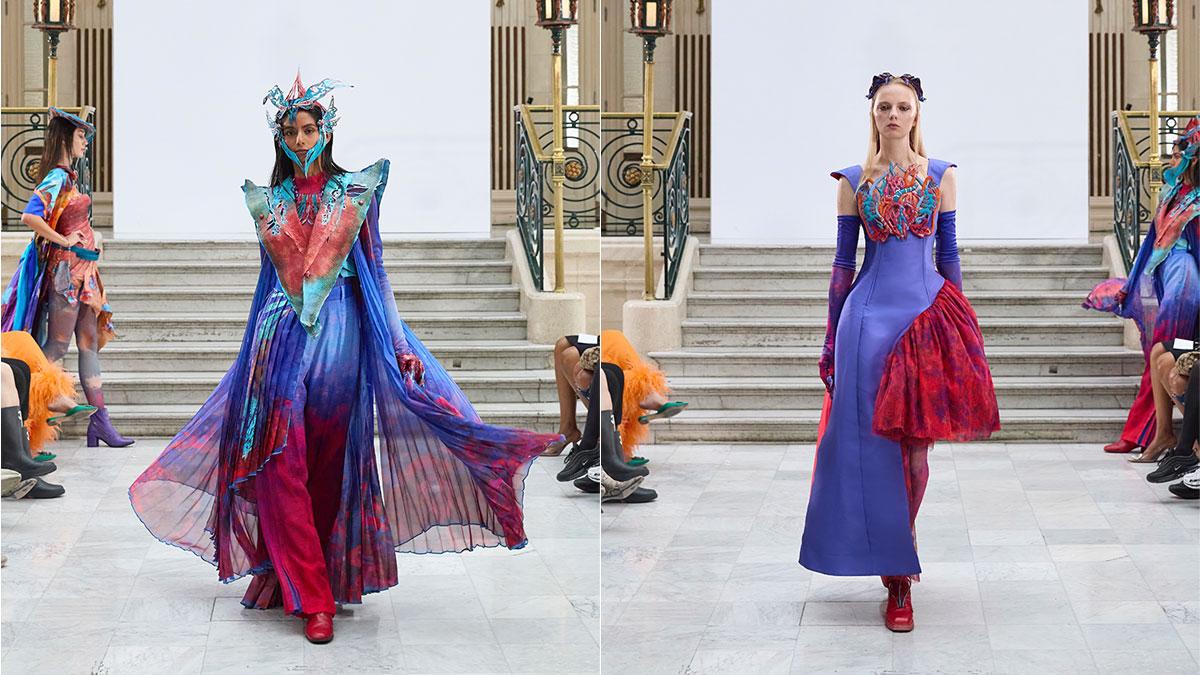
Rising sea levels and climate change are forcing humanity to adapt and create new ways of living in a world increasingly dominated by water. This scenario, based on climate predictions for 2050, shows the resilience and ingenuity of humans in the face of environmental upheaval.
Lei Jiang’s work embodies this spirit of adaptation through her project “No-Land”, set in the year 2223. She creates a detailed vision of underwater citizens navigating a submerged world, going beyond fantastical scenarios to explore practical possibilities for human evolution.
“I want to show future human’s resilience and how we adapt to environmental change to create a new world,” Lei explains. She transforms fish skin and upcycled plastics into designs that embody transformation and survival, choosing materials linked to humanity’s origins in the sea.
Lei’s innovative work has been recognised at fashion film festivals in Milan and Berlin. Her education at the Royal College of Art and London College of Fashion forms the basis of her experimental approach, combining physical and digital techniques.
In her underwater narratives, Lei explores the concepts of eternity, romance and revolution – her vision of an ideal human existence. Her work invites us to imagine a world where beauty and sustainability coexist and gives us hope for the role of fashion in a time of ecological uncertainty.
Artistic Vision & Influences
In “No-Land”, Lei creates three distinct underwater citizens that embody different aspects of the future society. Licht (who appears in virtual form as Lux) serves as a neighbour figure, while Lacey acts as a landlord and collector and Lachesis operates a delivery service. Each character represents Lei’s vision of how humans might adapt to marine existence.
A collaboration with Kansai Yamamoto at the British Museum shaped Lei’s artistic direction. The project ‘Eternity, Romance and Revolution’ established her core principles: the everlasting life and regeneration ability of jellyfish, the romantic life form of whales, and the revolutionary pursuit of evolution and metamorphosis.
Lei’s creative process merges scientific knowledge with artistic innovation. She explores how humans might develop fish-like characteristics as they evolve, including the ability to change colour for camouflage or as a warning signal. This biological adaptation influences her choice of colours and materials, reflecting the gradual changes in ocean lighting at different depths.
Her experimental approach combines digital and physical techniques. Lei moves fluidly between character modeling, digital fashion, fish leather tanning and analogue photography. This mixed-media method allows her to explore the malleability of future human identities while challenging traditional methods of fashion production.
The collection rejects conventional seasonal structures and operates at the interface between performance costume and contemporary fashion. Each piece carries distinct character traits balancing theatrical elements with wearable design. With this approach, Lei creates a new fashion language that speaks to both current environmental concerns and future human possibilities.
Material Innovation & Technology
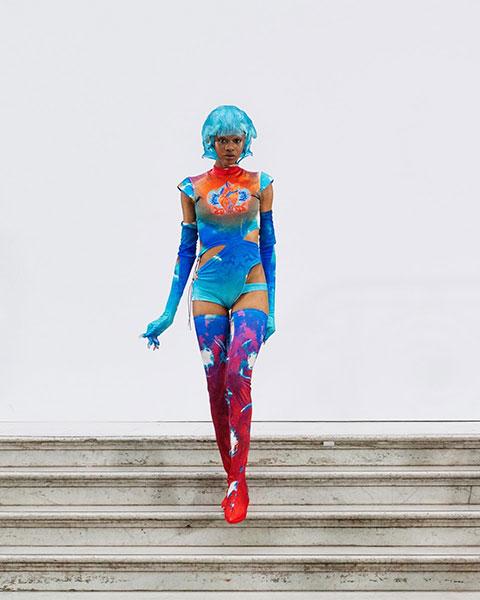
Lei’s choice of materials reflects a deep understanding of marine biology and human evolution. Her innovative use of fish skin stems from the fact that fish are the largest group of vertebrates, and represent a potential evolutionary bridge between marine and human life. This scientific approach informs both the choice of materials and the design process.
Her experimental techniques combine traditional craftsmanship with innovation. Beyond fish leather tanning, Lei incorporates metals that could theoretically help human bodies develop salt glands and adapt to the marine environment. This scientific foundation grounds her speculative designs in biological possibilities.
Colour plays a vital role in Lei’s work as she draws inspiration from marine biology. Her designs reflect the changing light conditions at various ocean depths and mirror the way sea creatures use colour to communicate and survive. This attention to ecological detail lends both authenticity and poetry to her underwater narratives.
Fish skin offers a sustainable alternative in fashion production, as for every tonne of processed fish fillets, around 40 kilogrammes of discarded skin is produced. This material, which has always been used by cultures in Scandinavia, Alaska, Japan, north-east China and Siberia, has considerable potential for sustainable fashion development.
Identity & Gender Expression
Marine biology inspires Lei’s vision of future human identity. She studies creatures that naturally switch or possess multiple biological gender features, questioning whether gender boundaries will persist in an evolved underwater world. “I am questioning if the gender boundaries still exist in the future context,” reflects Lei.
The change in human identity goes beyond gender and encompasses broader issues of adaptation and evolution. Lei is exploring how future humans might develop new ways of communicating and expressing themselves, similar to the ability of marine animals to change their colours and shapes.
“Are we building more artificial identities or genders in the future?” she asks, inviting viewers to question their own assumptions about gender expression through her designs. Human expression evolves alongside our physical adaptation to the environment, viewing transformation as an opportunity rather than a limitation.
The Cinematic Element
For Lei Jiang, fashion film isn’t just a medium, but an essential storytelling tool that brings her underwater narratives to life. “Fashion film played a huge part in my creations and final presentations,” Lei explains. “It is all about storytelling and fashion presentation in different characters that helps me to show solid visual identity”.
The immersive nature of the film allows Lei to fully realise her vision of an aquatic future. Her cinematic work has garnered recognition, including Official Selection at the Milan Fashion Film Festival and Best Fashion Film at the Berlin Kiez Film Festival.
Through the lens of fashion film, Lei’s designs become characters in an ongoing story of environmental adaptation and human resilience. The medium allows Lei to capture what static presentations cannot — the dynamic intersection of identity, environment and evolution.
As Lei continues to explore the possibilities of fashion film, she pushes the boundaries of how we experience and understand fashion narratives.
Conclusion
“Eternity like a jellyfish, romance like a whale, revolution through metamorphosis” — Lei´s poetic principles reflect a profound vision of human potential. Just as human civilisation originated in the ocean, our return to the marine environment may not be the end, but rather a circular journey of adaptation and growth.
How can avant-garde materials such as fish skin be scaled up for wider production? Can experimental designs retain their artistic integrity while becoming more accessible? These questions reflect the essence of Lei’s vision: the eternal regeneration of materials, the romantic pursuit of beauty and the revolutionary transformation of fashion itself.
Perhaps in this return to our marine origins lies the key to our future evolution — not only for our bodies, but also for our understanding of what it means to be human.